You just finished an acupuncture session feeling hopeful—maybe even a little relaxed—and then the next day, you wake up sore. Or the pain you came in for feels worse than before. That can be alarming, especially if this was your first treatment. The good news is that post-treatment discomfort is more common than most people expect, and in many cases, it is part of the body’s natural response to needling.
This article breaks down the real reasons behind severe pain after acupuncture, what is considered normal versus what warrants a call to your practitioner, and how working with a qualified clinic can make a meaningful difference in your experience and outcomes. We will also cover specific scenarios involving acupuncture lower back pain, acupuncture neck pain, acupuncture for sciatica pain, and foot acupuncture points—because the location of your treatment matters more than most people realize.
Key Takeaways
- Mild to moderate soreness after acupuncture is a normal response and typically fades within 24 to 48 hours.
- Severe or persistent pain after acupuncture may signal overstimulation, incorrect needle placement, or an underlying condition that needs attention.
- The area treated—whether for acupuncture lower back pain, acupuncture neck pain, or acupuncture for sciatica pain—affects how your body responds post-session.
- Staying hydrated, resting, and avoiding strenuous activity after treatment can reduce post-session discomfort.
- Working with a licensed, board-certified practitioner significantly lowers the risk of adverse reactions.
- If pain is sharp, spreading, or accompanied by other symptoms, contact your acupuncturist or a medical provider promptly.
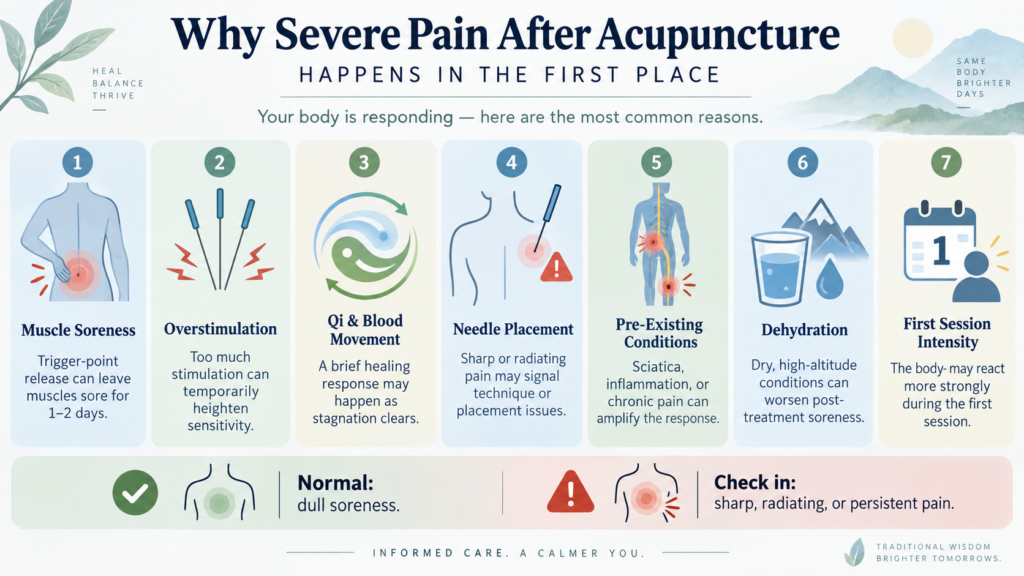
Why Severe Pain After Acupuncture Happens in the First Place
Most people expect acupuncture to feel gentle—and for many, it does. But the body does not always respond predictably, and several factors can contribute to a more intense post-treatment experience. Understanding those factors helps you make sense of what your body is doing rather than assuming something went wrong.
Acupuncture works by stimulating specific points along the body’s meridian pathways to encourage circulation, reduce tension, and support the nervous system. When needles are inserted—especially into areas already holding chronic tension like the lower back, neck, or along the sciatic nerve pathway—the surrounding tissue responds. That response can include temporary inflammation, muscle twitching, or a dull ache that lingers after the session ends.
This is not the same as injury. It is closer to the soreness you might feel after a deep tissue massage or a new workout. The distinction matters.
1. Muscle Soreness From Needle Stimulation
When a needle reaches a tight or knotted muscle, the tissue can contract briefly—a response called a local twitch response. This is actually a sign the needle is doing its job, releasing a trigger point. The muscle may feel sore for a day or two afterward, similar to how a muscle feels after it has been worked.
This is especially common with acupuncture lower back pain treatments, where deep paraspinal muscles are often targeted.
2. Overstimulation During the Session
More needles or stronger stimulation does not always mean better results. If a treatment is too aggressive for your current state—especially if you came in depleted, stressed, or in a flare—your nervous system can react with increased sensitivity. This can make existing acupuncture pain feel temporarily worse before it improves.
Experienced practitioners adjust needle depth, retention time, and stimulation based on your presentation that day, not a fixed protocol.
3. Qi and Blood Movement in Traditional Chinese Medicine
From a Traditional Chinese Medicine perspective, acupuncture moves what is called Qi (energy) and Blood through channels that may have been stagnant. When stagnation begins to clear, there can be a brief period of discomfort as circulation is restored to areas that were previously blocked. This is sometimes described as a healing response or a therapeutic aggravation.
It tends to be short-lived and is followed by noticeable improvement—though it can feel discouraging in the moment.
4. Incorrect Needle Placement or Technique
This is less common with licensed practitioners, but it is worth acknowledging. If a needle is placed incorrectly—too deep, at the wrong angle, or near a nerve—it can cause sharp or radiating pain during or after the session. This type of acupuncture pain feels different from normal soreness. It is often more localized, sharper, and may not resolve within 24 to 48 hours.
If you experience this, contact your practitioner. A qualified acupuncturist will take your feedback seriously and adjust accordingly.
5. Pre-Existing Conditions That Amplify Response
If you are managing acupuncture for sciatica pain, nerve compression, or inflammatory conditions, your baseline sensitivity is already elevated. Needling near inflamed or compressed nerve pathways—including foot acupuncture points that connect to the sciatic nerve—can produce a stronger reaction than expected. This does not mean acupuncture is wrong for you. It means the treatment plan may need to be modified.
Conditions like fibromyalgia, neuropathy, or autoimmune disorders also affect how the body responds to needling and should be disclosed before treatment begins.
6. Dehydration and Post-Treatment Neglect
Colorado Springs sits at over 6,000 feet elevation, and the dry, high-altitude environment already pulls moisture from the body faster than most people realize. If you arrive at your appointment dehydrated—or leave without drinking water afterward—your muscles and connective tissue have less fluid to recover with. This can amplify soreness and slow the body’s ability to process the treatment.
Drinking water before and after your session is one of the simplest ways to reduce post-acupuncture discomfort.
7. First-Session Intensity
Your first acupuncture session introduces your body to something it has not experienced before. The nervous system is essentially learning how to respond. For some people, this means a stronger initial reaction—more soreness, more fatigue, or a temporary increase in symptoms. This often levels out significantly by the second or third visit as the body adapts.
Knowing this in advance makes the experience far less alarming.
Normal Post-Acupuncture Soreness vs. Severe Pain After Acupuncture: What Is the Difference
Not all post-treatment discomfort is the same, and it helps to know what falls within a normal range versus what signals a problem. The table below outlines the key differences so you can assess your situation clearly.
| Normal Soreness | Severe or Concerning Pain |
|---|---|
| Dull ache or tenderness at needle sites | Sharp, stabbing, or burning pain |
| Resolves within 24 to 48 hours | Persists beyond 48 to 72 hours |
| Mild fatigue or heaviness | Significant swelling, bruising, or redness |
| Temporary increase in existing symptoms | New symptoms not present before treatment |
| Feels similar to post-massage soreness | Radiating pain or numbness spreading from the treatment area |
| Improves with rest and hydration | Does not improve or worsens with rest |
If your experience falls into the right column, reach out to your acupuncturist or a medical provider. Do not wait it out hoping it resolves on its own.
At Acupuncture Colorado Springs, David W. Armstrong, L.Ac. takes post-treatment feedback seriously. If something does not feel right after your session, you can contact the clinic directly at 2525 W Pikes Peak Ave, Suite B, Colorado Springs, CO 80904. We would rather hear from you early than have you manage something uncomfortable alone.
How Treatment Area Affects Severe Pain After Acupuncture for Lower Back, Neck, and Sciatica
The location of your acupuncture treatment plays a significant role in how your body responds afterward. Different regions of the body carry different levels of muscle density, nerve sensitivity, and chronic tension—all of which influence post-session discomfort.
For acupuncture lower back pain, the lumbar region holds some of the body’s densest muscle groups. Deep needling in this area—especially for people who have been managing chronic pain for months or years—often produces more noticeable post-treatment soreness. The muscles have been compensating for a long time, and releasing that tension takes adjustment.
Acupuncture neck pain treatments involve an area rich in nerve pathways and close to the cervical spine. Soreness here can sometimes feel more acute simply because of the density of structures in a small space. Practitioners working in this region need to be precise, and patients should expect some tenderness for a day or two.
Acupuncture for sciatica pain often involves needling along the hip, gluteal region, and even foot acupuncture points that correspond to the sciatic nerve pathway. Because sciatica itself involves nerve irritation, the post-treatment response can feel more pronounced. Some patients report a temporary flare of their sciatic symptoms before experiencing relief—this is a known pattern and typically resolves within a few days.
You might be wondering whether this means acupuncture is making things worse. In most cases, it is not. The body is responding, adjusting, and beginning to shift patterns that have been set for a long time. That process is rarely entirely comfortable.
What You Can Do to Reduce Severe Acupuncture Pain After Your Session
There are practical steps you can take to support your body after treatment and minimize the chance of significant post-session discomfort.
- Drink water before and after your appointment, especially in Colorado Springs’ dry climate.
- Rest for the remainder of the day if possible. Avoid intense exercise or strenuous activity for at least 24 hours.
- Apply gentle heat to sore areas if the soreness feels muscular. Avoid ice unless your practitioner specifically recommends it.
- Eat a light meal before your session. Arriving on an empty stomach can increase lightheadedness and sensitivity.
- Communicate openly with your practitioner about your pain levels during and after treatment. They can adjust needle depth, number of needles, or stimulation technique based on your response.
- Avoid alcohol for 24 hours after treatment. It can interfere with the body’s recovery process and amplify inflammation.
- Follow up if something does not feel right. A brief check-in with your acupuncturist can clarify whether what you are experiencing is expected or needs attention.
These are not complicated steps. Most of them come down to giving your body the space and resources it needs to do what the treatment set in motion.
If you are looking for a care plan that accounts for your specific history, pain patterns, and how your body has responded to treatment in the past, our clinic offers exactly that. At Acupuncture Colorado Springs, every treatment begins with a real conversation—not a generic intake form. David W. Armstrong, L.Ac. designs each session around where you are that day, not a fixed protocol. You can learn more about our approach or book a consultation through our services page.
When to Seek Additional Support After Severe Acupuncture Pain
There are situations where post-acupuncture discomfort warrants more than rest and water. Knowing when to seek additional care is part of being an informed patient.
Contact your acupuncturist or a medical provider if you experience sharp or radiating pain that does not improve within 48 hours, significant swelling or bruising at needle sites, fever or signs of infection, numbness or tingling that spreads beyond the treatment area, or dizziness or nausea that persists after the session. These are not typical responses and deserve prompt attention.
Beyond acupuncture itself, our clinic also supports patients through complementary therapies including cupping, which can be helpful during recovery from intense treatment sessions. Cupping, in particular, may help reduce muscle tension and improve circulation in areas that are slow to recover. If you are managing ongoing acupuncture pain between sessions, these options are worth exploring as part of a broader care plan.
Closing Thoughts on Managing Severe Pain After Acupuncture
Post-treatment soreness is a real and common part of the acupuncture experience, but severe or persistent pain is a signal worth taking seriously. Working with a licensed, experienced practitioner—one who listens, adjusts, and follows up—makes a meaningful difference in both your safety and your results. If you are in the Colorado Springs area and want care that is personalized, grounded, and responsive to how your body actually feels, we invite you to reach out to Acupuncture Colorado Springs and start with a conversation.
Acupuncture Colorado Springs offers board-certified, personalized acupuncture care to minimize discomfort and support real healing. David W. Armstrong, L.Ac. identifies root causes, not just symptoms. Get started today—call us!
FAQs
Is It Normal to Have Severe Pain After Acupuncture?
Severe pain is not typical after acupuncture. Mild soreness, heaviness, or a brief ache at a needle site can happen, but intense or worsening pain may signal irritation of a sensitive area, a muscle spasm, or (rarely) an injury and should be assessed—especially if it doesn’t quickly improve.
What Causes Increased Pain After Acupuncture Treatment?
Increased pain can come from temporary post-treatment soreness, a localized inflammatory response as tissues relax, treating a very tight or inflamed area, or doing more activity than usual afterward. Less commonly, a needle may irritate a muscle or superficial nerve. In our clinic, we tailor point selection and technique to your presentation to minimize flare-ups.
How Long Should Pain Last After Acupuncture?
Most post-acupuncture soreness resolves within a few hours to 48 hours. If pain is severe, steadily worsening, or lasting longer than 2–3 days, it’s a good idea to contact your acupuncturist for guidance and consider medical evaluation if symptoms are concerning.
When Should I Worry About Pain After Acupuncture and See a Doctor?
Seek urgent medical care if you have severe or rapidly worsening pain, significant swelling, redness spreading or warmth, fever, shortness of breath, chest pain, fainting, new weakness or numbness, loss of bladder/bowel control, or a severe headache—especially after needling near the neck or upper back. If you’re unsure, call your practitioner promptly for next-step advice.
Can Acupuncture Cause Nerve Damage or Injury?
Permanent nerve damage from acupuncture is very rare when performed by a licensed, well-trained clinician using appropriate depth and technique. Temporary nerve irritation (tingling, zinging, or localized sensitivity) can occur and usually resolves. Using sterile, single-use needles and careful anatomical technique—standards we follow—helps keep risks low.