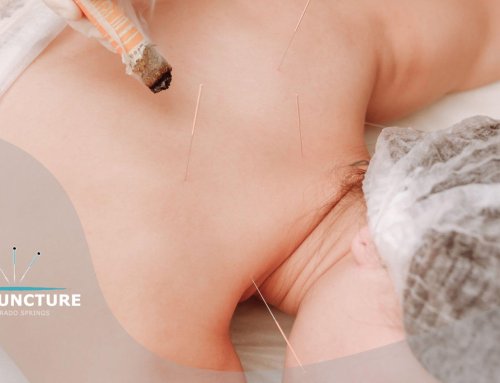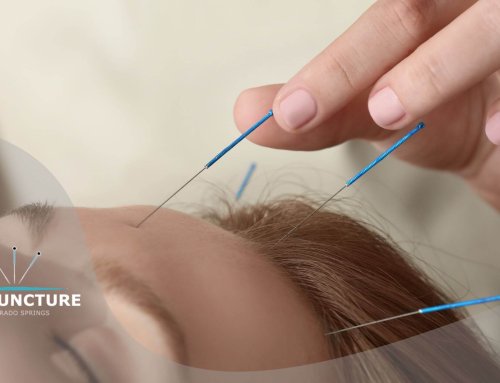
You lie down, the acupuncture needles are placed, and then—unexpectedly—you feel a wave of emotion rising. Maybe your eyes water. Maybe you feel a sudden heaviness in your chest, followed by a strange sense of lightness. If this has happened to you, or if you are curious whether it could, you are not alone. Many people who receive acupuncture report emotional responses they did not anticipate, and it leaves them wondering what exactly is going on beneath the surface.
This article explores the connection between acupuncture and emotional release—what it means from both a Traditional Chinese Medicine perspective and a modern physiological standpoint, why it happens, what to expect during and after a session, and how to find the right support. We will also look at what current research says, where the evidence is strong, and where it is still developing.
Key Takeaways
- Acupuncture emotional release is a real and commonly reported experience that many patients encounter during or after a session.
- Traditional Chinese Medicine views emotions as connected to specific organ systems, and acupuncture points are selected to address those patterns.
- Modern research suggests acupuncture may influence the nervous system and stress hormones, which could play a role in emotional responses.
- Evidence on acupuncture for anxiety and depression is still mixed, and reported benefits may reflect a combination of specific and nonspecific effects.
- Working with a licensed, board-certified practitioner ensures that your sessions are safe, personalized, and grounded in clinical experience.
- Acupuncture Colorado Springs offers individualized care plans that address both physical and emotional health patterns.
Can Acupuncture Emotional Release Really Happen During a Session?
Yes, it can. Acupuncture emotional release refers to the spontaneous surfacing of emotions—tears, laughter, grief, anxiety, or a deep sense of calm—that some people experience during or shortly after acupuncture treatment. It is not a side effect in the traditional sense. Many practitioners consider it a sign that the body is responding and shifting. The experience varies widely from person to person, and not everyone has it.
From a Traditional Chinese Medicine standpoint, this makes a certain kind of sense. TCM does not separate the emotional body from the physical body. Grief, for example, is associated with the Lung meridian. Anger connects to the Liver. Fear relates to the Kidney system. When acupuncture needles are placed at specific acupuncture points along these meridians, the intention is to move stagnant energy—what TCM calls Qi—and restore flow. Emotional release may simply be what that movement feels like from the inside.
That said, it is worth being honest about what science currently confirms and what remains uncertain.
What Acupuncture and Pain Management Research Actually Says About Emotional Responses
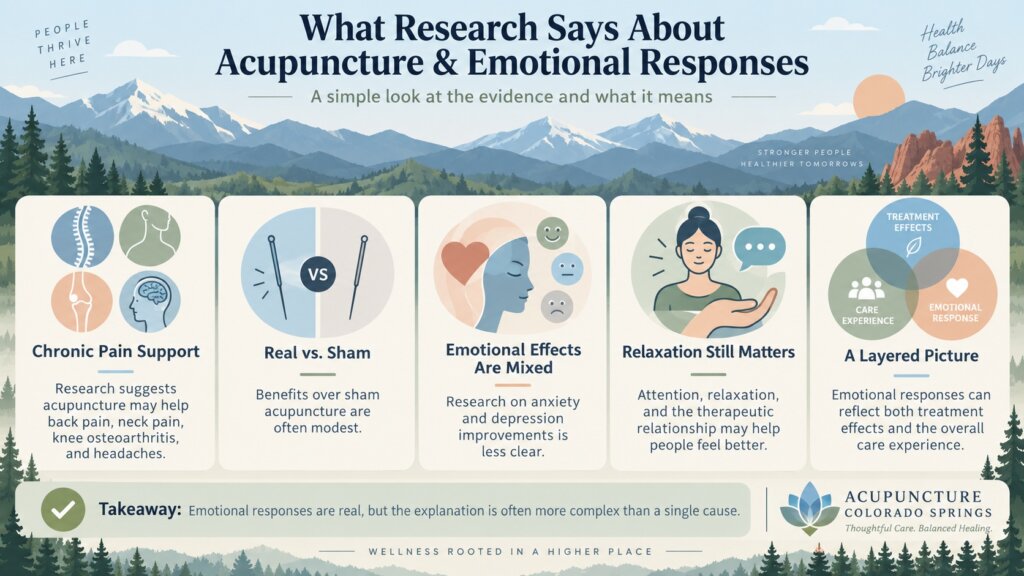
The National Center for Complementary and Integrative Health (NCCIH) reports that acupuncture may help with several chronic pain conditions, including back pain, neck pain, osteoarthritis-related knee pain, and headaches. These findings are meaningful. At the same time, NCCIH notes that the differences between real acupuncture and sham acupuncture—where needles are placed at non-traditional points or do not penetrate the skin—are often smaller than the differences between acupuncture and receiving no treatment at all.
This distinction matters when we talk about emotional release. A 2022 systematic review examining acupuncture for emotional symptoms in patients with functional gastrointestinal disorders found that improvements in anxiety and depression, compared with sham acupuncture, were not statistically significant. The authors acknowledged that reported benefits could reflect specific acupuncture effects, placebo effects, or nonspecific effects like relaxation, attention, and therapeutic relationship.
None of this means acupuncture does not support emotional well-being. It means the picture is more layered than a simple cause-and-effect explanation. And in clinical practice, layered is often exactly what emotional health looks like.
Key Research Findings at a Glance
A 2022 systematic review and meta-analysis published in PMC (National Institutes of Health) examined acupuncture’s effects on anxiety and found statistically significant reductions in anxiety symptoms compared to control groups. A later research compilation categorized the clinical evidence across emotional and psychological conditions:
| Condition | Evidence Level | Primary Mechanism Studied |
|---|---|---|
| Generalized Anxiety | Moderate to High | HPA axis regulation, cortisol reduction |
| Depression | Moderate | Serotonin and dopamine modulation |
| PTSD Symptoms | Moderate | Amygdala activity, autonomic nervous system |
| Emotional Stress | Moderate | Parasympathetic activation |
| Insomnia from Anxiety | High | Melatonin, cortisol, nervous system tone |
These findings do not mean acupuncture replaces therapy or medication for serious mental health conditions.
How Acupuncture Points May Influence the Nervous System and Emotional State
One of the more compelling physiological explanations for acupuncture emotional release involves the autonomic nervous system. Acupuncture appears to shift the body from a sympathetic state—fight or flight—toward a parasympathetic state, often called rest and digest. This shift alone can produce emotional responses, because many people carry chronic stress so constantly that they have forgotten what it feels like to fully exhale.
When the nervous system downregulates during a session, stored tension can surface. This is not unique to acupuncture. It happens in yoga, breathwork, and certain forms of bodywork as well. What makes acupuncture distinctive is the precision of acupuncture points and the way a trained practitioner selects them based on your individual pattern—not a generic protocol.
You might be wondering whether the needles themselves cause discomfort that triggers an emotional response. In most cases, acupuncture needles are extremely fine, and insertion is either painless or produces a mild sensation described as pressure, warmth, or a dull ache. Emotional responses are generally not caused by pain from the needles.
The Du26 Acupuncture Point and Its Role in Emotional Regulation
Located on the philtrum, the groove between the nose and upper lip, Du26 (also called Renzhong or GV26) is a point on the Governing Vessel meridian, which runs along the spine and connects to the brain. It has been used historically for resuscitation, mental clarity, and acute emotional distress. Stimulation of this point may influence brainstem activity and autonomic tone, and it is often combined with other points like Pericardium 6 and Heart 7 for anxiety and emotional distress.
Common Emotional Experiences People Report During Acupuncture Treatment
People describe a wide range of emotional experiences during acupuncture sessions. Understanding what others have felt can help you feel more prepared and less caught off guard if something similar happens to you.
1. Unexpected Tears or Sadness
Some patients cry during a session without knowing why. This is one of the most commonly reported forms of acupuncture emotional release. It often passes quickly and is followed by a sense of relief.
2. A Wave of Calm or Emotional Numbness
Others describe feeling emotionally blank in a peaceful way—like the volume on their internal noise has been turned down. For people dealing with burnout or chronic stress, this can feel unfamiliar but welcome.
3. Sudden Anxiety or Agitation
Occasionally, a patient may feel a brief increase in anxiety or restlessness before settling. This is less common, and a skilled practitioner will adjust point selection if it persists.
4. Laughter or a Sense of Joy
Some people laugh unexpectedly or feel a lightness they cannot explain. In TCM, this is sometimes associated with the Heart system coming back into balance.
5. Grief or a Feeling of Loss
Points along the Lung meridian, often used for respiratory support or immune function, are also associated with grief in TCM. Some patients report feeling a release of old sadness they had not consciously accessed.
6. Deep Relaxation Followed by Emotional Clarity
Perhaps the most commonly reported experience overall is a deep, almost meditative relaxation that leads to greater emotional clarity after the session. Patients often describe feeling more grounded, less reactive, and more able to process what they have been carrying.
Is Acupuncture Emotional Release Safe? What You Should Know
Safety is a reasonable concern, and it deserves a direct answer. Acupuncture is generally safe when performed by a licensed, trained practitioner using sterile, single-use needles. Serious complications are uncommon but can occur if proper technique and hygiene are not followed, which is why choosing a board-certified provider matters.
Emotional release during a session is not harmful. It is a normal physiological and psychological response. What matters is that you feel supported in the moment, and that your practitioner creates a calm, private space where you feel comfortable letting your guard down.
At Acupuncture Colorado Springs, every session begins with a thorough intake conversation. David W. Armstrong, L.Ac., takes time to understand your health history, stress levels, and emotional patterns before selecting acupuncture points. That context shapes every treatment decision. If emotional responses come up during your session, they are met with calm and care—not alarm.
If you are dealing with significant mental health concerns alongside physical symptoms, acupuncture can be part of a broader care plan that includes licensed mental health support. We are transparent about what acupuncture can and cannot do, and we will always refer you to additional resources when appropriate.
Who Is Most Likely to Experience Acupuncture Emotional Release?
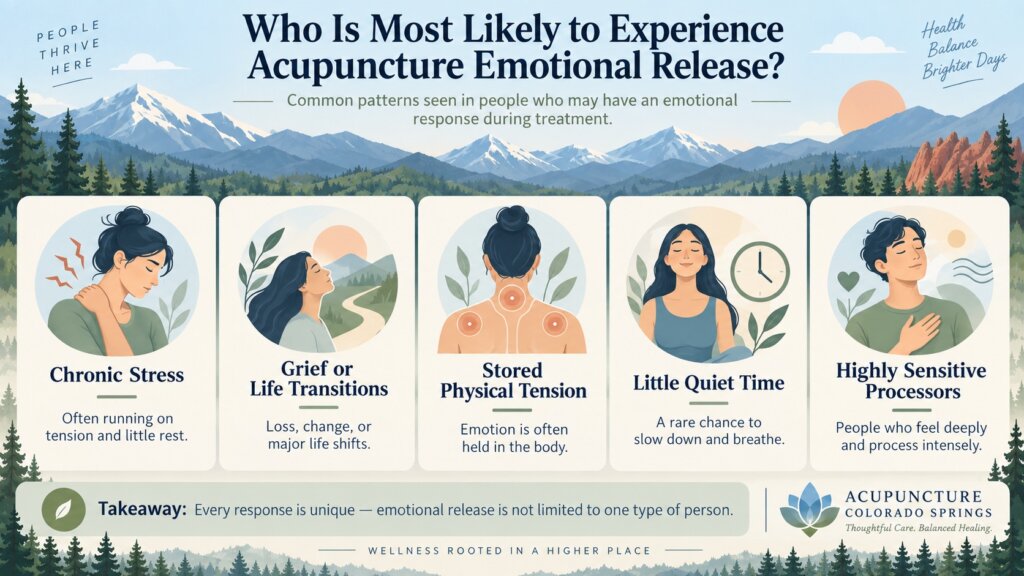
There is no single profile for who will have an emotional response during acupuncture treatment. That said, certain patterns tend to show up more often in clinical practice.
- People who carry chronic stress and rarely give themselves permission to slow down.
- Individuals dealing with grief, loss, or major life transitions.
- Patients with a history of physical tension in areas like the chest, shoulders, or jaw—places where emotion is often held somatically.
- Those who have not had a quiet, uninterrupted hour to themselves in a long time.
- People who are highly sensitive to physical sensation and tend to process experiences deeply.
If you recognize yourself in any of these descriptions, acupuncture may offer more than pain relief. It can create a rare opportunity to pause, be still, and let your body do what it has been trying to do for a while.
How Acupuncture Colorado Springs Supports Emotional and Physical Well-Being
Our clinic serves patients across Colorado Springs, Manitou Springs, Old Colorado City, and Woodland Park. Many of the people who come through our doors are dealing with the kind of stress that accumulates quietly—demanding jobs, physical labor, family pressure, and the particular fatigue that comes from living at altitude in a fast-moving city. Emotional health and physical health are rarely separate issues, and we treat them that way.
David W. Armstrong, L.Ac., brings decades of clinical experience to every session. His approach to acupuncture and pain management is rooted in Traditional Chinese Medicine but informed by current research. He does not promise outcomes. He works with you to identify patterns, set realistic goals, and build a care plan that fits your actual life—not a textbook version of it.
Beyond acupuncture, our clinic offers cupping therapy and Chinese herbal medicine guidance. These modalities can complement your acupuncture sessions and support emotional regulation, physical recovery, and long-term resilience. If you are curious about how cupping or herbal support might fit into your care, we encourage you to ask during your first visit or reach out to our team before you book.
| Experience | TCM Interpretation | Possible Physiological Explanation |
|---|---|---|
| Unexpected tears | Lung or Heart meridian releasing stagnation | Parasympathetic activation, emotional processing |
| Deep calm | Shen (spirit) settling | Reduced cortisol, nervous system downregulation |
| Brief anxiety | Qi moving through blocked channels | Temporary sympathetic response before settling |
| Laughter or lightness | Heart Qi expanding | Endorphin release, mood shift |
| Grief surfacing | Lung meridian clearing | Somatic release of stored emotional tension |
| Post-session clarity | Balanced Qi flow across meridians | Improved HRV, reduced stress hormone activity |
What to Expect If You Have an Emotional Response During Your Session
If you experience an emotional release during acupuncture, the most important thing is to let it move through without forcing it or suppressing it. You do not need to explain it or make sense of it in the moment. Your practitioner will not be alarmed, and you are not doing anything wrong.
After your session, give yourself a few minutes before rushing back into the day. Drink water. Move gently. Some people feel tired afterward; others feel unusually clear-headed. Both are normal. Emotional processing can continue for a day or two after treatment, which is why we recommend noting how you feel in the days following your session—it gives us useful information for your next visit.
If you are new to acupuncture and want to know more about what a first session looks like from start to finish, our What Is Acupuncture page walks through the full process in plain language.
Wrapping Up: What Acupuncture Emotional Release Means for Your Health
Acupuncture emotional release is real, it is common, and it is not something to fear. It reflects the body’s capacity to shift when given the right conditions—stillness, safety, and targeted support through precise acupuncture points. The research is still evolving, and we believe in being honest about that, but clinical experience and patient reports consistently point to something meaningful happening in these moments. If you are ready to explore what acupuncture can do for your emotional and physical health, we invite you to schedule a consultation with Acupuncture Colorado Springs and take that first step toward more balanced, grounded well-being.
Acupuncture Colorado Springs offers personalized, root-cause-focused acupuncture care to help you process stress and restore emotional balance. David W. Armstrong, L.Ac., guides every session with compassion and clinical expertise. Book your appointment today—get started on your healing journey.
FAQs
What Is an Emotional Release During Acupuncture?
An emotional release is a temporary wave of feelings—such as relief, sadness, or calm—that can surface during or after acupuncture as your nervous system shifts out of “fight-or-flight” and your body lets go of stored tension. In Traditional Chinese Medicine, it’s often viewed as movement of stuck energy (qi) and a sign your system is rebalancing.
Is It Normal to Cry or Feel Emotional After Acupuncture?
Yes. Some people cry, feel tender, or notice unexpected emotions after a session, and it’s generally considered a normal response—especially when stress, pain, or prolonged tension has been held in the body. At Acupuncture Colorado Springs, we tailor treatment to your comfort and check in throughout the visit.
How Long Does Emotional Release Last After Acupuncture?
It varies, but many people feel “lighter” within minutes to a few hours, while others may notice emotional sensitivity for a day or two. If feelings feel intense or persist, we adjust your treatment plan and pacing to better support your nervous system and overall balance.
Can Acupuncture Help With Trauma or Anxiety-Related Emotional Release?
Acupuncture may help support trauma- and anxiety-related symptoms by calming the stress response, improving sleep, and easing physical tension that often accompanies emotional strain. We take a root-cause, individualized approach and can coordinate with your mental health care when appropriate, since acupuncture is supportive care and not a replacement for therapy.
What Should I Do After an Emotional Release From Acupuncture?
Hydrate, eat something nourishing, and give yourself a quieter evening if possible. Gentle movement, a warm bath, journaling, or rest can help you integrate the shift; avoid over-scheduling or intense workouts if you feel raw. If you have concerns or feel overwhelmed, contact our clinic so we can guide you and refine your next session.