If you have been dealing with hot flashes, disrupted sleep, or mood shifts during menopause, you have probably wondered whether acupuncture could actually help. And if you are curious enough to look into it, one of the first questions that comes up is a very practical one: where exactly do the needles go? It is a fair question, and the answer is more specific than most people expect.
This article walks you through the actual body points used in menopause acupuncture protocols, what Traditional Chinese Medicine theory says about them, and what current research suggests about how well they work. You will also learn how a personalized treatment plan differs from a generic one, and why that distinction matters for your results.
Key Takeaways
- Acupuncture for menopause targets specific body points on the legs, feet, lower back, and abdomen rather than internal organs.
- The most commonly used points include SP6, KI3, BL23, CV4, LV3, and PC6, chosen based on meridian theory.
- Research shows acupuncture may reduce hot flashes and improve sleep, though it does not consistently outperform sham needling in controlled trials.
- TCM practitioners select points based on your individual pattern, not a one-size-fits-all protocol.
- Hormonal imbalance acupressure points overlap significantly with those used in acupuncture for fertility and other hormonal concerns.
- Personalized care from a licensed acupuncturist offers a more targeted approach than self-guided acupressure alone.
Where Do Acupuncture Needles Go for Menopause? The Specific Points Explained
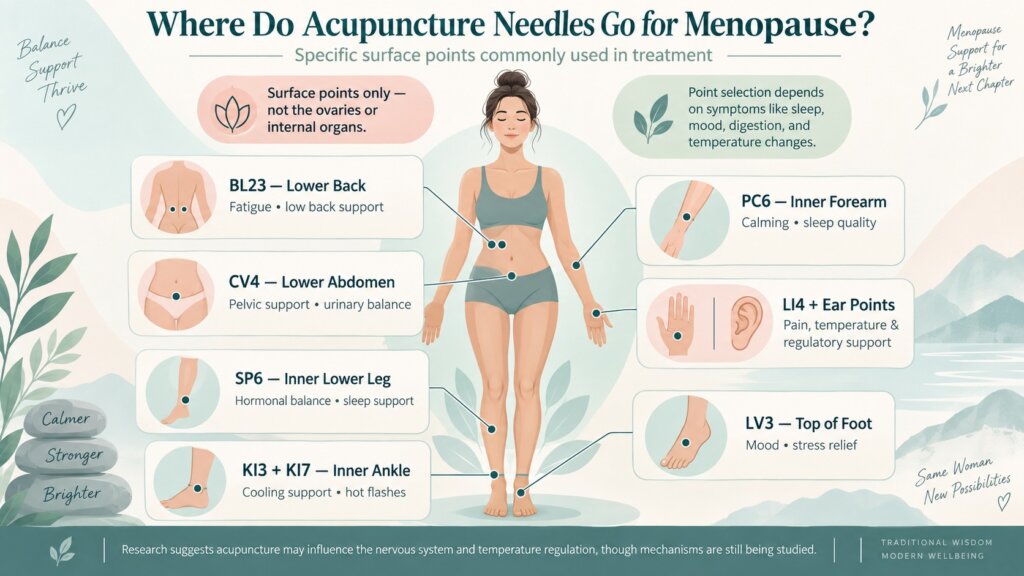
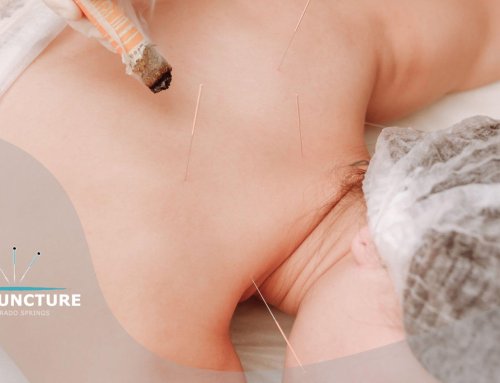
Acupuncture for menopause does not involve needling the ovaries or any internal reproductive organ. Instead, licensed acupuncturists place thin, sterile needles at specific surface points on the body, selected based on their relationship to meridians, or energy pathways, that TCM theory links to hormonal and thermal regulation. These points are located on the hands, lower legs, feet, lower back, and lower abdomen, and each one carries a distinct function within the TCM framework.
The selection process is more nuanced than picking points off a chart. A trained practitioner evaluates your full symptom picture, including sleep quality, emotional state, digestion, and body temperature patterns, before deciding which combination of points to use.
You might be wondering whether these points actually connect to anything measurable in the body. Research does show that needling certain locations can influence the autonomic nervous system, affect neurotransmitter activity, and modulate the hypothalamic-pituitary axis, which plays a central role in regulating body temperature and hormone output. That said, the precise mechanism is still being studied.
1. SP6 Sanyinjiao (Inner Lower Leg)
SP6 is located about three finger-widths above the inner ankle bone. It sits at the intersection of the spleen, liver, and kidney meridians, which makes it one of the most frequently used hormonal imbalance acupressure points in all of TCM gynecology.
In menopause protocols, SP6 is used to support hormonal balance, calm the nervous system, and address sleep disturbances. It appears in nearly every clinical trial protocol reviewed for menopausal symptoms.
2. KI3 Taixi and KI7 Fuliu (Inner Ankle Area)
KI3 sits in the depression between the inner ankle and the Achilles tendon. KI7 is located just above it, along the kidney meridian pathway. In TCM, the kidney system governs reproductive aging, and these points are central to addressing what practitioners call kidney yin deficiency, a pattern commonly associated with hot flashes, night sweats, and dryness.
Stimulating these points is thought to support the body’s cooling mechanisms and replenish what TCM describes as foundational energy, or jing, that depletes with age.
3. BL23 Shenshu (Lower Back)
BL23 is located on the lower back, roughly at the level of the second lumbar vertebra, on either side of the spine. It is the kidney’s back-shu point, meaning it directly influences kidney organ function in TCM theory.
This point is used in protocols targeting fatigue, low libido, lower back aching, and reproductive decline. It also appears in acupuncture points for male fertility protocols, where it supports testicular function and sperm parameters alongside CV4 and DU4.
4. CV4 Guanyuan (Lower Abdomen)
CV4 sits on the midline of the lower abdomen, about three finger-widths below the navel. It is one of the most significant points on the conception vessel meridian and is used across a wide range of reproductive and hormonal conditions.
In menopause care, CV4 is needled to support what TCM calls the uterine vessel and to address symptoms like pelvic coldness, urinary frequency, and emotional instability. It also appears prominently in acupuncture for fertility points protocols for both women and men.
5. LV3 Taichong (Top of the Foot)
LV3 is located on the top of the foot, in the webbing between the first and second toes. The liver meridian, in TCM, plays a major role in the smooth flow of qi and blood, and disruptions to this flow often manifest as irritability, headaches, and mood swings during menopause.
Practitioners use LV3 to ease emotional symptoms and reduce what TCM describes as liver qi stagnation. It pairs well with LI4 on the hand, forming a combination called the Four Gates, often used for stress and pain relief.
6. PC6 Neiguan (Inner Forearm)
PC6 sits on the inner forearm, about two finger-widths above the wrist crease. It is widely used for nausea, anxiety, and palpitations, all of which can appear during perimenopause and menopause.
In hormonal protocols, PC6 is chosen to calm the heart and settle the spirit, which in TCM terms relates to emotional steadiness and sleep quality. It is a gentle but effective point that most patients find calming during treatment.
7. LI4 Hegu (Hand) and Ear Points
LI4 is located in the fleshy web between the thumb and index finger. It is one of the most studied acupuncture points overall and is used in menopause protocols for its broad regulatory effects on pain, temperature, and nervous system tone.
Ear acupuncture, or auricular therapy, is sometimes added to body point protocols. Small needles or seeds are placed on ear points corresponding to the uterus, kidney, and endocrine system, offering an additional layer of support between sessions.
Now that you have a clear picture of the specific points used, it helps to understand how these points are chosen in practice and what the research actually says about their effectiveness.
What the Research Says About Where Acupuncture Needles Go for Menopause and Hormonal Imbalance Acupressure Points
The research on acupuncture for menopause is genuinely interesting, and also a little complicated. A large pragmatic trial known as the AIM study found that acupuncture delivered in routine clinical settings reduced hot flash frequency and improved sleep quality compared to no acupuncture at all. That is a meaningful finding for anyone suffering through multiple hot flashes a day.
Where the picture gets more nuanced is in sham-controlled trials. Multiple systematic reviews show that acupuncture does not consistently outperform sham needling, where needles are placed at non-traditional points or retractable needles are used, for hot flash reduction. This suggests that some of the benefit may come from non-specific effects: the therapeutic relationship, relaxation, attention, and the physiological response to needling in general, rather than the precise location of each needle.
That does not mean the point selection is arbitrary. Clinical protocols still follow consistent patterns based on TCM theory and decades of practice. The acupressure points for hormonal imbalance used in menopause care overlap significantly with those used in acupuncture points for male fertility and acupuncture points for erectile dysfunction protocols, all of which center on the kidney, liver, and conception vessel meridians. The shared logic reflects a coherent theoretical system, even if the science has not yet fully confirmed point-specific mechanisms.
| Acupuncture Point | Location | Primary Use in Menopause | Also Used In |
|---|---|---|---|
| SP6 Sanyinjiao | Inner lower leg | Hormonal balance, sleep, mood | Fertility, PMS, digestive support |
| KI3 Taixi | Inner ankle | Hot flashes, night sweats, dryness | Male fertility, fatigue |
| BL23 Shenshu | Lower back | Fatigue, low libido, back ache | Male fertility, kidney support |
| CV4 Guanyuan | Lower abdomen | Pelvic symptoms, emotional stability | Fertility points, ED protocols |
| LV3 Taichong | Top of foot | Irritability, headaches, mood swings | Stress, pain, ED support |
| PC6 Neiguan | Inner forearm | Anxiety, palpitations, sleep | Nausea, emotional regulation |
| LI4 Hegu | Hand | Temperature regulation, pain | General pain, stress response |
Understanding the research helps set realistic expectations. But knowing how a practitioner applies this knowledge in a real session is what actually shapes your experience and your outcomes.
How Personalized Acupuncture for Menopause Differs From a Generic Protocol
One thing that gets lost in research summaries is that real clinical acupuncture is not a fixed recipe. At Acupuncture Colorado Springs, every patient who comes in for menopause-related symptoms starts with a detailed intake conversation covering their full health history, sleep patterns, emotional state, digestion, and how their symptoms actually feel day to day. David W. Armstrong, L.Ac., uses that information to identify the underlying TCM pattern driving the symptoms before selecting a single point.
For example, two women experiencing hot flashes may receive very different treatments. One might present with classic kidney yin deficiency, characterized by heat, dryness, and night sweats, and receive a protocol centered on KI3, SP6, and CV4. Another might show signs of liver qi stagnation with heat, marked more by irritability, headaches, and flushing, and receive a protocol that emphasizes LV3, PC6, and GB34. Same chief complaint, different root patterns, different point selections.
This is where the value of working with a board-certified practitioner becomes clear. If you are navigating perimenopause or menopause and want support that goes beyond symptom management, we invite you to schedule a consultation at our clinic at 2525 W Pikes Peak Ave, Suite B, Colorado Springs, CO 80904. We serve patients throughout El Paso County, including Manitou Springs, Old Colorado City, and Woodland Park, and every treatment plan is built around your specific pattern, not a generic protocol.
Beyond acupuncture itself, our clinic also offers Chinese herbal medicine guidance as a complementary layer of support. Certain herbal formulas have been used for centuries to address the kidney and liver patterns associated with menopausal symptoms, and David can help you determine whether herbal support makes sense alongside your acupuncture care.
What to Expect During an Acupuncture Session for Menopause
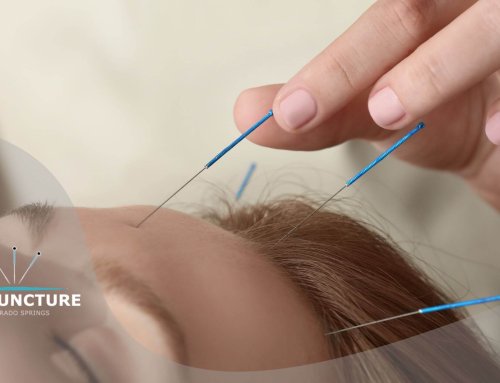
If you have never had acupuncture before, the idea of needles can feel intimidating. In practice, most patients find the experience much gentler than they expected. The needles used are hair-thin, sterile, and single-use, and the sensation, if you feel anything at all, is often described as a mild pressure, warmth, or a brief dull ache that fades quickly.
A typical session for menopause lasts between 45 and 60 minutes. You will lie comfortably on a treatment table while the needles are placed, usually at points on your lower legs, feet, lower back, and abdomen. Many patients fall asleep during the retention period, which lasts around 20 to 30 minutes. That kind of deep relaxation is itself part of the therapeutic effect.
Most practitioners recommend starting with a series of weekly sessions, often six to ten, before assessing progress. Menopause is not a condition that resolves after one visit, and the cumulative effect of regular treatment tends to produce more lasting results than sporadic care. At our clinic, we track your progress at each visit and adjust the point selection as your pattern shifts.
Connecting Menopause Care to Broader Hormonal Health
It is worth noting that the acupressure points for hormonal imbalance used in menopause protocols are not exclusive to women’s health. The same kidney, liver, and conception vessel points that appear in menopause care also show up in acupuncture for fertility points protocols, in treatments for acupuncture points for erectile dysfunction, and in approaches targeting acupuncture points for male fertility.
This overlap reflects something important about how TCM understands hormonal health: it is a whole-body system, not a compartmentalized set of organs. The kidney meridian, for instance, governs reproductive vitality across the lifespan and across genders. Treating it through points like KI3, BL23, and CV4 addresses a shared root, whether the presenting concern is menopausal symptoms, low testosterone, or fertility challenges.
If you are supporting a partner through fertility treatment or dealing with your own hormonal concerns alongside menopause, our clinic can address multiple patterns within a single, coordinated care plan. We also offer cupping therapy as an adjunct treatment that supports circulation, reduces tension, and complements the effects of acupuncture.
Conclusion
Acupuncture for menopause targets specific, well-mapped body points on the legs, feet, back, and abdomen, chosen based on your individual TCM pattern rather than a fixed script. The research supports real benefits for hot flashes and sleep, even if the precise mechanisms are still being studied. If you are ready to explore personalized, root-cause-focused care for menopause symptoms, book a consultation with Acupuncture Colorado Springs and let us build a plan that fits you.
Acupuncture Colorado Springs offers personalized, root-cause-focused acupuncture care to ease menopause symptoms naturally. Board-certified practitioner David W. Armstrong, L.Ac., designs treatment plans tailored to your unique needs. Get started today by booking your first appointment.
FAQs
Where Do Acupuncture Needles Go for Menopause Symptoms?
Needles are placed at specific points that match your symptom pattern—often on the wrists, forearms, lower legs/ankles, abdomen, and sometimes the upper back or scalp. In our Colorado Springs clinic, David W. Armstrong, L.Ac. selects points based on your full history (sleep, stress, digestion, cycle changes, heat sensations) rather than using a one-size-fits-all protocol.
What Acupuncture Points Are Used for Hot Flashes and Night Sweats?
Commonly used points may include areas associated with regulating temperature, calming the nervous system, and supporting hormonal transition—often on the inner ankle, lower leg, wrist/forearm, and lower abdomen. Exact point selection varies by person and may change visit to visit depending on hot flash frequency, sleep quality, and stress levels.
How Many Acupuncture Sessions Are Needed for Menopause Relief?
Many patients start with 1 session per week for 4–8 weeks, then taper as symptoms stabilize. Some notice improvements sooner, while longer-standing or more complex symptoms may take more time; we reassess regularly and adjust your plan to your response and goals.
Does Acupuncture Really Help Menopause Symptoms Like Hot Flashes and Insomnia?
For many people, acupuncture can help reduce hot flash intensity/frequency and support better sleep by improving stress regulation and overall balance. Results vary, but our approach is to target both symptom relief and the underlying patterns contributing to sleep disruption, mood changes, and temperature swings.
Are There Any Risks or Side Effects of Acupuncture for Menopause?
Acupuncture is generally low-risk when performed by a licensed professional using sterile, single-use needles. Possible side effects include mild soreness, small bruising, temporary fatigue, or brief symptom fluctuations; serious complications are rare. We review your health history and medications to keep care safe and appropriate.