If you’ve been asking yourself how often should I do acupuncture, you’re not alone. It’s one of the most common questions people have before starting care, and the answer isn’t a single number. Frequency depends on what you’re dealing with, how long you’ve had it, and how your body responds over time.
This article breaks down the general treatment schedules used in clinical practice, what the research says about acupuncture frequency, and how conditions like chronic pain, stress, and injury each call for a different approach. You’ll also find a simple comparison table to help you figure out where you might fall.
Key Takeaways
- Acute conditions typically call for 2–3 sessions per week for 2–3 weeks, while chronic issues are usually addressed with 1–2 sessions per week over 6–8 weeks.
- Most people begin with a more frequent schedule and taper down to monthly maintenance once symptoms stabilize.
- Does acupuncture really work? Research shows moderate-to-high certainty of benefit for conditions like neck pain, low back pain, fibromyalgia, and allergic rhinitis.
- Evidence for some conditions is still low-certainty, so a licensed practitioner should help set realistic expectations.
- Treatment frequency is not one-size-fits-all and should be reassessed regularly based on how you respond.
- Complementary therapies like cupping and Chinese herbal medicine can support and extend the effects of acupuncture between sessions.
How Often Should I Do Acupuncture: The Direct Answer by Condition Type
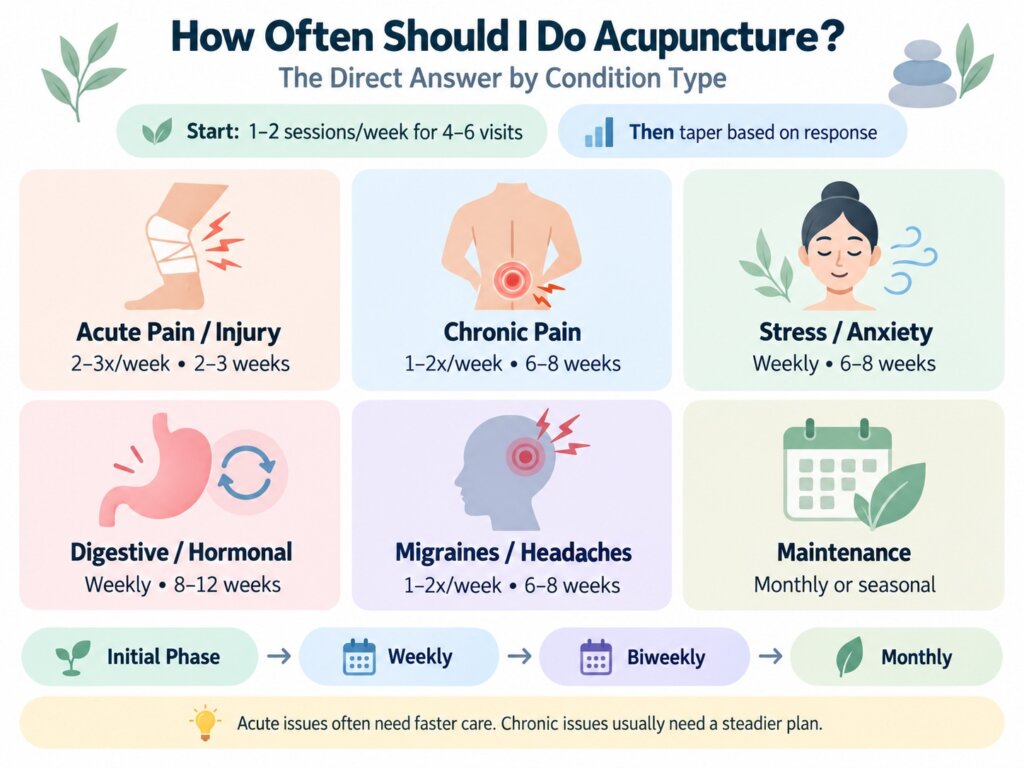
The most practical way to answer this question is to start with what you’re treating. Clinical guides consistently suggest beginning with 1–2 sessions per week for 4–6 visits, then tapering based on how your body responds. After that initial phase, many patients move to weekly, then biweekly, and eventually monthly maintenance visits once symptoms have stabilized.
That said, the starting point varies depending on whether your condition is acute or chronic. Acute situations, like a sudden muscle injury or a sharp flare-up of pain, often benefit from a faster pace. Chronic patterns that have built up over months or years usually need a longer, steadier approach.
Here’s a straightforward breakdown of how often acupuncture is typically recommended by condition type:
1. Acute Pain or Sudden Injury
For sudden injuries, intense pain, or post-surgical recovery, many practitioners recommend 2–3 sessions per week for 2–3 weeks. The goal is to reduce inflammation, ease muscle tension, and support the body’s initial healing response before spacing out visits.
2. Chronic Pain Conditions
Chronic low back pain, neck and shoulder pain, fibromyalgia, and myofascial pain typically require 1–2 sessions per week for 6–8 weeks. Systematic reviews have found moderate-to-high certainty evidence supporting acupuncture for these conditions, making them some of the most well-researched applications of this therapy.
3. Stress, Anxiety, and Burnout
For people dealing with ongoing stress, anxiety, or burnout, weekly sessions for 6–8 weeks are a common starting point. Results tend to build gradually, and many patients notice meaningful shifts in sleep quality and stress response within the first month.
4. Digestive and Hormonal Concerns
Conditions like PMS, irregular cycles, or digestive discomfort often follow a cycle-based treatment schedule. Weekly sessions for 8–12 weeks are common, with adjustments made based on how symptoms shift across the month.
5. Migraines and Recurring Headaches
Acupuncture for migraines is typically approached with 1–2 sessions per week over 6–8 weeks. Some studies suggest that a consistent course of treatment may reduce both the frequency and severity of episodes over time.
6. Maintenance and Long-Term Wellness
Once your primary concerns have improved, monthly maintenance sessions are often enough to sustain results. Some patients come in seasonally, especially in Colorado Springs where altitude, dry air, and shifting seasons can affect energy, immunity, and joint comfort.
Now that you have a clearer picture of frequency by condition, it’s worth looking at what the research actually says about whether acupuncture works and for whom.
Does Acupuncture Really Work? What the Research Shows
You might be wondering whether the evidence behind acupuncture is solid or still speculative. The honest answer is: it depends on the condition. Research quality varies widely, and that’s worth knowing before you start.
Overviews of systematic reviews have found moderate or large effects with moderate-to-high certainty for a specific set of conditions. These include neck and shoulder pain, nonspecific low back pain, fibromyalgia, myofascial pain, allergic rhinitis, and short-term lactation support. For these, the evidence is meaningful enough that many integrative medicine guidelines now include acupuncture as a recommended option.
For other conditions, including some popular topics discussed in online spaces like does acupuncture work Reddit threads covering IBS, mood disorders, or addiction, the data is more limited. Broad evidence mapping shows that many acupuncture studies for adult health conditions yield low or very low certainty of benefit compared with sham acupuncture. That doesn’t mean acupuncture doesn’t help in those cases. It means the research hasn’t caught up yet, and that larger, high-quality trials are still needed to draw firm conclusions.
One thing the research does consistently confirm: acupuncture is generally safe when performed by a trained, licensed professional using sterile, single-use needles. Serious adverse events are rare.
At Acupuncture Colorado Springs, David W. Armstrong, L.Ac. takes an evidence-informed approach to every care plan. That means being honest about what acupuncture can and cannot do, and building a treatment schedule that reflects both your goals and what the research supports for your specific condition. If you’re curious about what acupuncture is good for in your situation, a one-on-one consultation is the best place to start. Book an appointment to speak with David directly about your health history and what a realistic plan might look like for you.
With that context in mind, let’s look at the factors that actually shape how often you should come in.
What Factors Determine How Often I Should Do Acupuncture
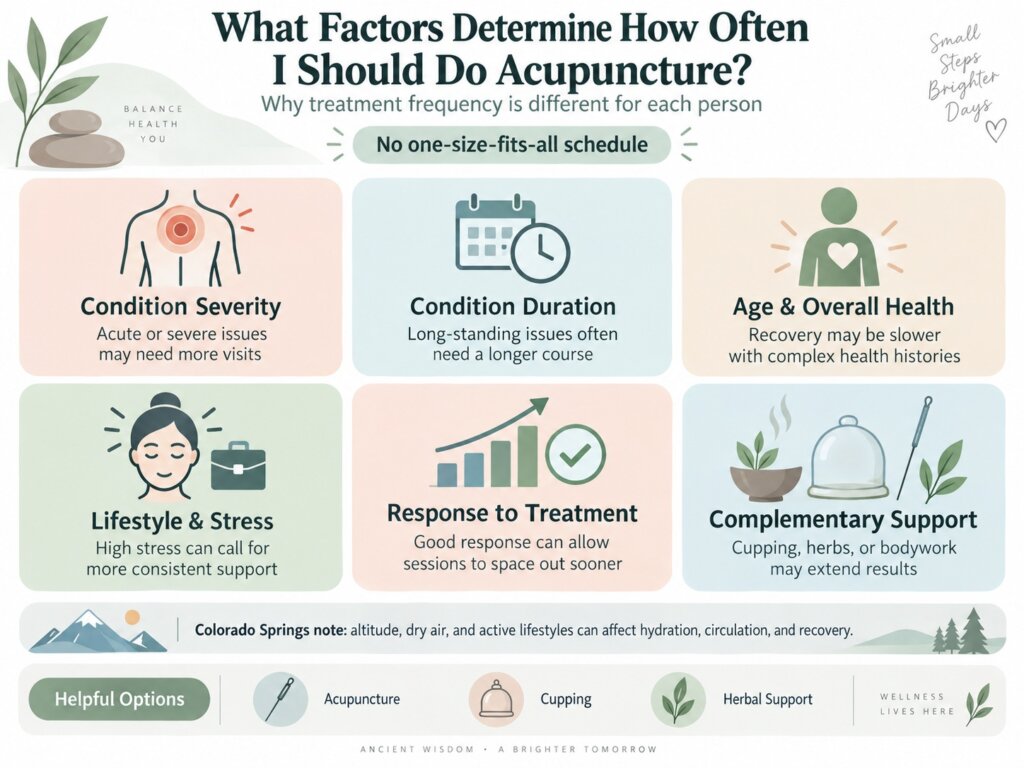
There’s no universal schedule that works for everyone, and any practitioner who hands you a fixed plan without asking questions first is skipping an important step. Several variables influence how frequently you should receive treatment, and all of them matter.
| Factor | How It Affects Frequency |
|---|---|
| Condition severity | More severe or acute conditions typically need more frequent sessions early on |
| Condition duration | Long-standing chronic issues usually require a longer treatment course |
| Age and overall health | Older patients or those with complex health histories may respond more gradually |
| Lifestyle and stress levels | High daily stress can slow recovery and may call for more consistent support |
| Response to treatment | If you respond quickly, sessions can be spaced out sooner |
| Complementary support | Adding cupping, herbal medicine, or bodywork can extend the effects of each session |
For patients in Colorado Springs specifically, altitude and dry climate are real factors. High-altitude living affects circulation, hydration, and recovery. People who hike, ski, or work physically demanding jobs here often carry more cumulative strain in their bodies than they realize. That context shapes the care plan.
Speaking of complementary support, our clinic offers cupping therapy and Chinese herbal medicine guidance alongside acupuncture. These aren’t add-ons for their own sake. They’re tools that can help your body hold the results of each session longer, which sometimes means you can taper to less frequent visits sooner than you might expect. Explore our full range of services to see how these therapies work together.
How Often Should I Do Acupuncture Compared to Other Therapies Like Red Light Therapy
A question that comes up occasionally, especially among patients researching natural health options, is how acupuncture compares to other therapies in terms of session frequency. Does red light therapy actually work the same way, and how often do you need it?
Red light therapy, also called low-level laser or photobiomodulation therapy, does have emerging evidence for specific applications. A recent clinical trial studying children with myopia used twice-daily 3-minute sessions, 7 days per week, and found meaningful changes in axial length. That’s a very specific, protocol-driven use case. Like acupuncture, red light therapy appears to work best when the frequency matches the condition, not a general wellness claim.
Acupuncture and red light therapy are similar in that both are condition-dependent and protocol-driven. They differ in mechanism, depth of research for different conditions, and the role of practitioner assessment. Acupuncture involves a trained clinician reading your body’s patterns and adjusting treatment in real time. That adaptive element is part of what makes it effective for complex or overlapping conditions.
The takeaway is that frequency matters for both therapies. More sessions are not always better. The right schedule, guided by someone who knows what they’re doing, is what produces results.
What to Expect as Your Treatment Plan Evolves
A lot of people come in expecting to feel dramatically different after one or two sessions. Sometimes that happens. More often, change builds gradually, and the pattern of improvement tells your practitioner a lot about what’s happening underneath the surface.
Here’s a general picture of how a treatment plan might evolve over time:
- Weeks 1–3: More frequent sessions (1–3 per week) to build momentum and begin shifting the underlying pattern.
- Weeks 4–8: Weekly sessions to consolidate progress and address any remaining symptoms.
- Months 2–4: Biweekly sessions as symptoms stabilize and your body holds results longer between visits.
- Ongoing: Monthly maintenance, or seasonal check-ins, to sustain long-term balance and catch any early signs of imbalance before they become bigger problems.
This progression isn’t rigid. If you plateau or have a flare-up, the schedule adjusts. If you respond faster than expected, you move to maintenance sooner. The plan follows you, not the other way around.
At our clinic, every treatment begins with a conversation, not a clipboard. David W. Armstrong, L.Ac. takes time to understand your health history, your daily life, and your goals before recommending a schedule. That’s what root-cause care looks like in practice. If you’re ready to find out what a personalized plan might look like for you, reach out to us or book a consultation at our Colorado Springs location at 2525 W Pikes Peak Ave, Suite B.
Final Thoughts on Acupuncture Frequency and Getting the Best Results
Getting the most from acupuncture comes down to consistency, realistic expectations, and working with someone who treats you as an individual. The right frequency is the one that fits your condition, your schedule, and how your body actually responds over time. Start where the evidence and your practitioner point you, then adjust as you go.
Acupuncture Colorado Springs offers personalized treatment plans tailored to your unique healing timeline. Board-certified L.Ac. David Armstrong builds schedules that deliver real, lasting results. Get started today and feel the difference custom care makes.
FAQs
How Many Acupuncture Sessions Do You Need to See Results?
Many people notice some change within 1–3 sessions, but more lasting results often take 6–12 treatments—especially for chronic or complex issues. At Acupuncture Colorado Springs, we tailor frequency and duration based on your history, goals, and how your body responds.
Is It OK to Do Acupuncture Every Day?
In some situations, short-term daily acupuncture can be appropriate (for example, acute pain or a flare), but it’s not necessary for most people. We typically recommend a schedule that supports progress without overdoing it, and we adjust based on your response and overall health.
How Often Should You Do Acupuncture for Chronic Pain?
A common starting point is 1–2 sessions per week for 4–6 weeks, then tapering to weekly or every other week as pain and function improve. Chronic pain usually responds best to consistent care early on, followed by a maintenance plan if needed.
How Often Should You Do Acupuncture for Anxiety or Stress?
Many patients do well with weekly sessions at first, then every other week as symptoms stabilize. During high-stress periods, 1–2 times per week may be helpful; we personalize the plan to support steady nervous system regulation and better resilience.
How Long Should You Wait Between Acupuncture Sessions?
For most concerns, spacing treatments 3–7 days apart at the beginning helps build momentum. As you improve, waiting 1–3 weeks between sessions is often enough to maintain results, depending on your condition and goals.