You’ve probably seen the title “acupuncture doctor” on a clinic sign or website and paused for a second. Are they an actual doctor? Do they go to medical school? Can you trust them with your health? These are fair questions, and you deserve a straight answer. The short version: licensed acupuncturists are not medical doctors in the conventional sense, but they are highly trained, board-certified healthcare professionals who specialize in a distinct and evidence-informed system of medicine.
This article breaks down exactly what acupuncture doctors are, how their training compares to that of medical doctors, what credentials to look for, and how acupuncture fits into your broader healthcare plan. Whether you’re exploring acupuncture for chronic pain, stress, or another concern, understanding who you’re working with matters.
Key Takeaways
- Licensed acupuncturists are not medical doctors but hold advanced degrees in Traditional Chinese Medicine and acupuncture.
- Acupuncture doctors complete rigorous graduate-level training and must pass national board exams to practice.
- The FDA regulates acupuncture needles as medical devices, which speaks to the clinical legitimacy of the practice.
- Medicare now covers acupuncture for chronic low back pain, reflecting growing recognition of acupuncture benefits in mainstream healthcare.
- Acupuncture and pain management research continues to grow, with the NCCIH citing evidence for its effectiveness in several conditions.
- Working with a licensed acupuncturist in Colorado Springs means receiving care that is personalized, root-cause focused, and grounded in both tradition and modern evidence.
What Acupuncture Doctors Actually Are: The Real Answer
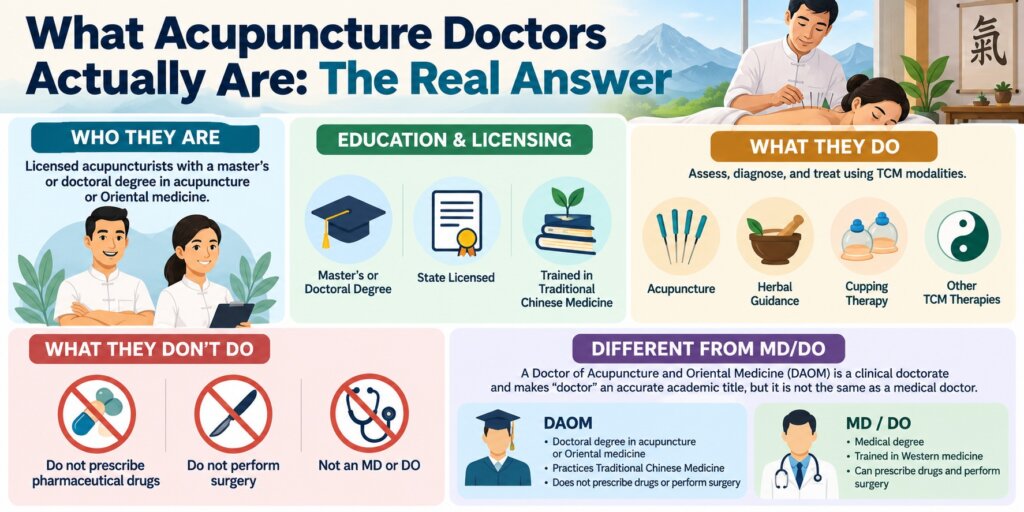
The term “acupuncture doctor” can mean different things depending on the context and the state. In most U.S. states, including Colorado, a licensed acupuncturist holds a master’s or doctoral degree in acupuncture or Oriental medicine, not a medical degree (MD) or doctor of osteopathic medicine (DO). They are not trained to prescribe pharmaceutical drugs or perform surgery. What they are trained to do is assess, diagnose, and treat health conditions through the lens of Traditional Chinese Medicine, which includes acupuncture, herbal guidance, cupping, and other modalities.
Some acupuncturists do hold a Doctor of Acupuncture and Oriental Medicine (DAOM) degree, which is a clinical doctorate. This makes “doctor” technically accurate as an academic title, similar to how a PhD holder is called a doctor, but it does not make them equivalent to a physician. The distinction matters, and any ethical practitioner will be upfront about it.
You might be wondering whether that distinction makes them less qualified to help you. It does not. It simply means they practice a different system of medicine, one that has been used for thousands of years and is increasingly supported by modern research.
How Acupuncture Doctor Training Compares to Medical Doctor Training
Understanding the difference in training helps you make an informed decision about your care. Both paths are demanding, but they are built around different frameworks of health and healing. Here is a side-by-side look at how the two compare.
| Training Area | Licensed Acupuncturist (L.Ac.) | Medical Doctor (MD) |
|---|---|---|
| Degree | Master’s (MAOM) or Doctorate (DAOM) | Doctor of Medicine (MD) |
| Program Length | 3–4 years graduate level | 4 years medical school + residency |
| Clinical Hours | 660–1,000+ supervised hours | Varies; thousands across residency |
| Board Certification | NCCAOM national board exams | USMLE licensing exams |
| Scope of Practice | Acupuncture, herbal medicine, bodywork | Pharmaceuticals, surgery, diagnostics |
| Primary Framework | Traditional Chinese Medicine (TCM) | Western biomedical science |
Licensed acupuncturists in Colorado must also meet state-specific licensing requirements and practice under regulations that include the use of sterile, single-use acupuncture needles. This is not optional. It is law.
What Credentials Acupuncture Doctors Hold and Why They Matter
When you walk into a legitimate acupuncture clinic, you should be able to verify your practitioner’s credentials without any guesswork. Most licensed acupuncturists in the United States are certified through the National Certification Commission for Acupuncture and Oriental Medicine, known as the NCCAOM. Passing those board exams requires mastery of acupuncture theory, point location, clean needle technique, and clinical assessment.
In Colorado, practitioners must also hold a state license issued by the Colorado Department of Regulatory Agencies. That license is not a formality. It requires documented education, clinical hours, and ongoing continuing education to maintain.
At Acupuncture Colorado Springs, David W. Armstrong, L.Ac. brings board certification and years of clinical experience to every patient interaction. Every session at our clinic on 2525 W Pikes Peak Ave, Suite B, Colorado Springs, CO 80904, begins with a thorough conversation about your health history, lifestyle, and goals. That is not a sales pitch. It is how good clinical care works.
What Is a Doctor of Acupuncture and When Does the Title Apply?
A doctor of acupuncture refers to someone who has completed a doctoral-level program such as a DACM (Doctor of Acupuncture and Chinese Medicine) or DAOM (Doctor of Acupuncture and Oriental Medicine). These are post-master’s programs that provide advanced clinical training, research skills, and deeper diagnostic expertise. The credential is one factor among many when evaluating a practitioner.
Are Acupuncturists Doctors in Colorado? State-Specific Licensing Rules
Acupuncturists in Colorado are licensed through the state’s regulatory framework and must comply with safety, hygiene, and scope-of-practice standards. They are distinct from physicians under Colorado law, and they do not hold prescribing authority. They can practice independently, accept patients without a physician referral in most cases, and offer a range of Traditional Chinese Medicine modalities within their defined scope.
Acupuncture Needles, FDA Oversight, and Clinical Safety
One of the most common concerns people have before their first session is whether acupuncture is safe. The FDA has weighed in on this. Acupuncture needles are classified as medical devices and are subject to federal regulation. Manufacturers must meet specific standards for sterility and quality before those needles can be sold or used in a clinical setting.
This regulatory framework is meaningful. It places acupuncture in a different category from unregulated wellness products or spa treatments. When a licensed acupuncturist uses needles in a clinical setting, they are using FDA-regulated tools under a state-issued license. That combination of oversight and training is what separates professional acupuncture care from anything you might find at a pop-up wellness booth.
The NCCIH, which is the National Center for Complementary and Integrative Health at the National Institutes of Health, notes that acupuncture is generally considered safe when performed by a trained and licensed practitioner using sterile needles. Serious adverse events are rare. Minor side effects like slight bruising or temporary soreness at needle sites do occur occasionally but are not common.
Acupuncture Benefits and What the Research Actually Supports
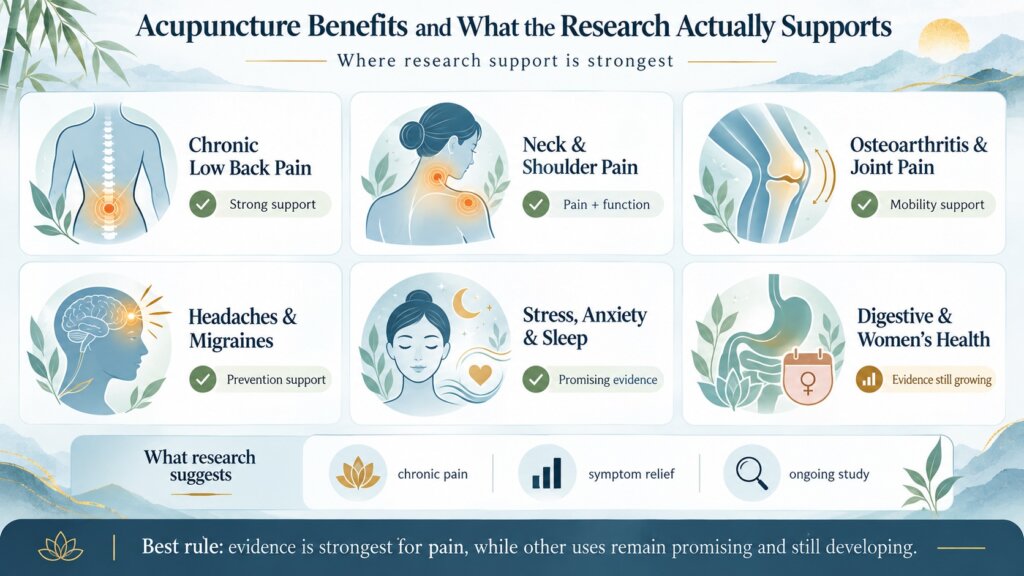
This is where things get more nuanced. Acupuncture has been studied extensively, and the evidence is stronger for some conditions than others. The NCCIH acknowledges research showing that acupuncture may help with chronic pain, including back pain, neck pain, osteoarthritis, and headaches. It has also been studied for anxiety, insomnia, and digestive issues, with promising but still-developing evidence.
Acupuncture and pain management, in particular, has received serious scientific attention. The NCCIH notes that acupuncture appears to go beyond a placebo effect in studies on chronic pain, which is a meaningful finding given how skeptical the research community has historically been about complementary therapies.
Here are some of the areas where acupuncture benefits are most supported by current research:
1. Chronic Low Back Pain
This is arguably the most well-documented application. Multiple clinical trials and systematic reviews support acupuncture as an effective option for reducing chronic low back pain. Medicare’s decision to cover acupuncture for this condition reflects that evidence base.
2. Neck and Shoulder Pain
Research suggests acupuncture may reduce pain and improve function in people with chronic neck and shoulder tension. For patients like construction workers or desk workers in Colorado Springs dealing with postural strain, this can be a meaningful option.
3. Osteoarthritis and Joint Pain
Studies included in NCCIH reviews indicate that acupuncture can support pain reduction and mobility in people with knee osteoarthritis. It is not a cure, but it may reduce reliance on over-the-counter pain medications.
4. Headaches and Migraines
Acupuncture has been studied as a preventive approach for tension headaches and migraines. Some research suggests it may be as effective as preventive drug therapy for some patients, with fewer side effects.
5. Stress, Anxiety, and Sleep Disruption
While the evidence here is still growing, acupuncture is widely used to support nervous system regulation. Many patients report improvements in sleep quality and stress levels after a course of treatment. This aligns with what we see clinically at our Colorado Springs practice.
6. Digestive and Women’s Health Concerns
Traditional Chinese Medicine has long addressed digestive function and hormonal balance. Research is ongoing, but acupuncture is commonly used to support conditions like IBS, PMS, and cycle irregularities. Our clinic works with patients navigating these concerns regularly.
Acupuncture Medicare Coverage: What It Tells You About Legitimacy
Medicare began covering acupuncture for chronic low back pain in 2020. This was not a small policy shift. Medicare is one of the most scrutinized healthcare programs in the country, and coverage decisions are based on clinical evidence and safety data. The fact that acupuncture made it through that process says something about where the medical community is heading in its view of complementary care.
Medicare covers up to 12 acupuncture sessions in 90 days for chronic low back pain, with an additional 8 sessions available if the patient shows improvement. That structure reflects a real treatment model, not a casual wellness experiment. If you are on Medicare and dealing with chronic back pain, this coverage may apply to you. It is worth checking with your provider about eligibility and whether your acupuncturist accepts Medicare.
This kind of mainstream recognition also reinforces why choosing a licensed, board-certified acupuncturist matters. Coverage and accountability go hand in hand.
How to Choose the Right Acupuncture Doctor for Your Needs
Not every acupuncture clinic operates the same way. Some are high-volume, in-and-out operations. Others, like Acupuncture Colorado Springs, take a different approach. Here is what to look for when evaluating a provider:
- Verify their license through your state’s regulatory board.
- Confirm NCCAOM board certification.
- Ask about their clinical experience with your specific condition.
- Find out how long initial consultations typically last and whether they include a full health history review.
- Ask about their approach to treatment planning. Is it individualized or protocol-based?
- Confirm they use sterile, single-use needles and follow hygiene standards.
- Check whether they offer complementary services like cupping therapy, Chinese herbal medicine guidance, or therapeutic massage that may support your care plan.
At our clinic, every patient begins with a thorough intake process led by David W. Armstrong, L.Ac. We look at your full health picture, including your lifestyle, stress load, sleep patterns, and physical symptoms, before designing a care plan. That process is what separates root-cause care from surface-level treatment.
We serve patients across the greater Colorado Springs area, including Manitou Springs, Old Colorado City, and Woodland Park. If you are ready to explore what personalized acupuncture care looks like, we invite you to schedule a consultation with our team. You can reach us at our clinic at 2525 W Pikes Peak Ave, Suite B, Colorado Springs, CO 80904, or book an appointment through our website.
Wrapping Up: What You Should Know Before Your First Visit
Acupuncture doctors are not medical doctors, but that does not make them less legitimate or less capable of helping you. They are trained professionals operating within a distinct, regulated, and evidence-informed system of care. Understanding that distinction helps you set the right expectations and make better decisions about your health. If chronic pain, stress, or a condition that has not responded well to conventional treatment is affecting your quality of life, acupuncture may be worth exploring with a qualified practitioner. The research supports it, Medicare recognizes it, and thousands of patients find real relief through it every year.
Acupuncture Colorado Springs is led by David W. Armstrong, a board-certified licensed acupuncturist. He delivers expert, root-cause care rooted in Traditional Chinese Medicine. Get started today and experience real, qualified healing.
FAQs
What Is an Acupuncture Doctor Called?
An acupuncture “doctor” is most commonly a licensed acupuncturist, often credentialed as L.Ac. (Licensed Acupuncturist). Some practitioners also hold advanced degrees in Traditional Chinese Medicine (TCM) and may use titles such as Doctor of Acupuncture and Chinese Medicine (DAcCHM) or Doctor of Acupuncture (DAc).
Is an Acupuncturist a Real Doctor?
Acupuncturists are real, state-licensed healthcare professionals, but they are not medical doctors (MDs) unless they also have medical school training. In Colorado, licensed acupuncturists must meet education, exam, and safety standards; at Acupuncture Colorado Springs, care is provided by David W. Armstrong, L.Ac., using sterile, single-use needles and evidence-informed, individualized treatment planning.
How Much Does Acupuncture Cost per Session?
Acupuncture cost per session varies by location, provider experience, and whether it’s an initial visit or follow-up. Many clinics charge more for the first appointment due to the longer intake and assessment, with follow-up sessions typically lower; for exact pricing and options, contact Acupuncture Colorado Springs directly.
What Does Acupuncture Treat?
Acupuncture is commonly used to support pain relief (neck, back, joints, headaches), stress and anxiety reduction, sleep, digestive concerns, and overall wellness. In TCM, treatment is tailored to the underlying pattern contributing to symptoms, which is why we begin with a thorough health history and goal-focused plan.
How Do I Find a Licensed Acupuncturist Near Me?
Look for a provider who is licensed in your state (in Colorado, typically an L.Ac.), has formal TCM training, follows clean-needle and single-use needle standards, and can clearly explain a personalized care plan. If you’re in Colorado Springs or nearby areas like Manitou Springs, Old Colorado City, or Woodland Park, you can schedule with Acupuncture Colorado Springs at our clinic on W Pikes Peak Ave.