You searched for acupuncture places in Colorado Springs, and you found dozens of listings with glowing five-star reviews. But here is the thing—a high rating tells you that people liked their experience. It does not tell you whether the practitioner is board-certified, whether they use sterile single-use acupuncture needles, or whether your treatment plan will actually address the root cause of your pain, fatigue, or stress. Those are the details that determine whether acupuncture works for you long-term.
This article breaks down what you should genuinely look for when choosing an acupuncture clinic in Colorado Springs—from practitioner credentials and treatment philosophy to how they handle acupuncture and pain management, how they differ from dry needling providers, and what a first visit should actually feel like. By the end, you will have a clearer picture of what separates a good clinic from a great one.
Key Takeaways
- Five-star reviews are a starting point, not the full picture when evaluating acupuncture places in Colorado Springs.
- Board certification and state licensure are non-negotiable markers of a qualified acupuncturist.
- Understanding the difference between dry needling vs acupuncture helps you choose the right treatment for your needs.
- Sterile, single-use acupuncture needles are a basic safety standard every reputable clinic should meet.
- Personalized care plans—not generic protocols—are what separate effective acupuncture from routine appointments.
- Acupuncture and pain management go hand in hand when the treatment is rooted in Traditional Chinese Medicine principles.
- Local factors like Colorado Springs’ altitude, dry climate, and active lifestyle should inform how your care is designed.
What Makes Acupuncture Places in Colorado Springs Worth Trusting for Acupuncture and Pain Management

When you are dealing with chronic back pain, tension headaches, or stress that just will not quit, you need more than a practitioner who is friendly and on time. You need someone who understands acupuncture and pain management at a clinical level—someone who can assess your full health picture and design a treatment that speaks to the underlying pattern, not just the symptom you walked in with. That is a meaningful distinction, and it is one that reviews rarely capture.
The National Center for Complementary and Integrative Health (NCCIH) notes that acupuncture has shown real promise for conditions like chronic low back pain, neck pain, osteoarthritis, and headaches. But the quality of that outcome depends heavily on the practitioner’s training and approach.
At Acupuncture Colorado Springs, led by David W. Armstrong, L.Ac., every patient begins with a detailed intake conversation—your health history, lifestyle, sleep patterns, stress levels, and goals all factor into the plan. That is not a formality. It is how effective acupuncture actually works.
Acupuncture Places and the Dry Needling vs Acupuncture Distinction You Should Know
One of the most common points of confusion when searching for acupuncture places in Colorado Springs is the difference between acupuncture and dry needling. Both involve inserting thin needles into the body, but the training, philosophy, and scope of practice are quite different. Knowing this distinction helps you make a more informed decision about where to go and what to expect.
A peer-reviewed study published in PubMed found that while dry needling and acupuncture share surface-level similarities, acupuncture is grounded in Traditional Chinese Medicine theory and requires significantly more hours of clinical training. Dry needling is typically practiced by physical therapists or chiropractors and focuses on muscular trigger points.
Acupuncture, by contrast, works within a broader diagnostic framework—one that considers the relationship between organ systems, energy flow, and whole-body balance. If you are looking for a practitioner who can address not just a tight muscle but the stress, sleep disruption, or hormonal imbalance contributing to that tension, a licensed acupuncturist is the right choice.
1. Check Licensure and Board Certification First
In Colorado, acupuncturists must be licensed by the state and are required to pass national board exams through the National Certification Commission for Acupuncture and Oriental Medicine (NCCAOM). This is your first filter when evaluating any acupuncture place in Colorado Springs. Do not skip this step—it is public information and easy to verify.
A short credential checklist:
- Active Colorado licensure, which you can verify through the state’s online license lookup. It shows the license number, issue date, expiration date, and any disciplinary actions.
- NCCAOM board certification, which requires passing comprehensive exams after completing an accredited educational program.
- Schooling at an institution accredited by the Accreditation Commission for Acupuncture and Oriental Medicine (ACAOM).
- Current continuing education in areas relevant to your health concerns.
- Professional liability insurance, which reputable practitioners carry.
2. Ask About Their Treatment Philosophy
A quality clinic will take time to explain their approach before a needle is placed. If a practitioner cannot clearly articulate how they assess your condition or why they recommend a specific number of sessions, that is worth noting. Root-cause care looks different from symptom-chasing, and you deserve to understand the difference.
3. Confirm They Use Sterile, Single-Use Acupuncture Needles
This is a basic safety standard, but it is worth asking directly. Reputable acupuncture places in Colorado Springs—including our clinic at 2525 W Pikes Peak Ave—use sterile, single-use acupuncture needles on every patient, every time. There is no acceptable exception to this practice.
4. Look for Personalized Care Plans, Not One-Size-Fits-All Sessions
Generic protocols might feel efficient, but they rarely produce lasting results. A skilled acupuncturist will adjust your treatment as your condition evolves—adding or modifying points, recommending complementary therapies like cupping or Chinese herbal medicine guidance, or shifting focus as your body responds. If every patient gets the same 45-minute session with the same points, that is a sign the approach is not truly individualized.
5. Evaluate Their Range of Complementary Services
Acupuncture works well on its own, but it often works better when paired with other Traditional Chinese Medicine modalities. Cupping therapy, therapeutic massage, and Chinese herbal medicine guidance can support the work done during an acupuncture session—especially for complex conditions like chronic pain, hormonal imbalance, or burnout. Ask what the clinic offers beyond the needle.
6. Consider Local Experience and Context
Colorado Springs has a specific health context that a locally experienced practitioner understands. High altitude affects hydration, sleep, and energy recovery. The dry climate stresses the body differently than humid environments. Active lifestyles—hiking, cycling, military fitness culture—create distinct patterns of overuse and injury. A practitioner who factors these realities into your care plan is offering something more relevant than a generic treatment approach.
7. Pay Attention to the Intake Process
Your first appointment should feel like a real conversation, not a rushed intake form. A thorough intake covers your medical history, current symptoms, sleep quality, digestion, emotional health, and lifestyle. If that conversation takes less than fifteen minutes, something is probably being skipped. The quality of your intake directly shapes the quality of your treatment.
With those criteria in mind, it becomes easier to see why star ratings alone are an incomplete guide. The next section looks at how to compare acupuncture places side by side using criteria that actually matter.
Comparing Acupuncture Places in Colorado Springs: A Practical Acupuncture Evaluation Matrix
When you are comparing multiple clinics, it helps to have a clear framework. The table below outlines the key criteria worth evaluating—and what to look for at each level. Use this as a starting point before you book your first appointment at any acupuncture place in Colorado Springs.
| Evaluation Criteria | What to Look For | Red Flags |
|---|---|---|
| Practitioner Credentials | State-licensed, NCCAOM board-certified L.Ac. | Unlicensed or credentials not publicly listed |
| Needle Safety | Sterile, single-use acupuncture needles confirmed | Vague answers about hygiene protocols |
| Treatment Approach | Root-cause focused, individualized care plans | Same protocol for every patient |
| Intake Process | Detailed health history, lifestyle, and goals discussion | Rushed or skipped intake |
| Complementary Services | Cupping or herbal guidance available | Acupuncture only, no integrative options |
| Local Relevance | Understands altitude, climate, and Colorado Springs lifestyle | Generic approach with no local context |
| Communication Style | Clear explanations, no pressure, patient-centered tone | Pushy upselling or vague treatment rationale |
You might be wondering how Acupuncture Colorado Springs holds up against these criteria. Our clinic meets each one. David W. Armstrong, L.Ac. is state-licensed and board-certified, uses sterile single-use needles on every visit, and builds every care plan around a thorough intake process. We also offer cupping therapy and Chinese herbal medicine guidance as part of an integrated approach to your care. If you are ready to see what personalized acupuncture looks like in practice, we invite you to schedule a consultation at our clinic on W Pikes Peak Ave.
How Acupuncture Places Handle Acupuncture and Pain Management Differently Than You Might Expect
Most people come to acupuncture places in Colorado Springs because something hurts—a lower back that flares up after long shifts, a neck that never fully loosens, or tension headaches that prescription medication barely touches. Acupuncture and pain management is one of the most well-researched applications of this medicine, and the NCCIH recognizes it as a legitimate complementary approach for chronic pain conditions. But how a clinic approaches pain treatment varies quite a bit.
Some clinics focus narrowly on the site of pain. A skilled acupuncturist looks at the broader pattern—what is contributing to the pain, what other systems are involved, and what lifestyle or environmental factors are keeping the body stuck. That broader view is what produces lasting results rather than temporary relief.
For patients in Colorado Springs dealing with pain from physically demanding work, high-altitude fatigue, or the wear that comes from an active outdoor lifestyle, this kind of whole-body assessment is especially relevant. Our clinic regularly works with patients managing chronic musculoskeletal pain, and we often integrate cupping therapy alongside acupuncture to support tissue recovery and reduce inflammation more effectively.
What a First Visit to Acupuncture Places in Colorado Springs Should Actually Feel Like
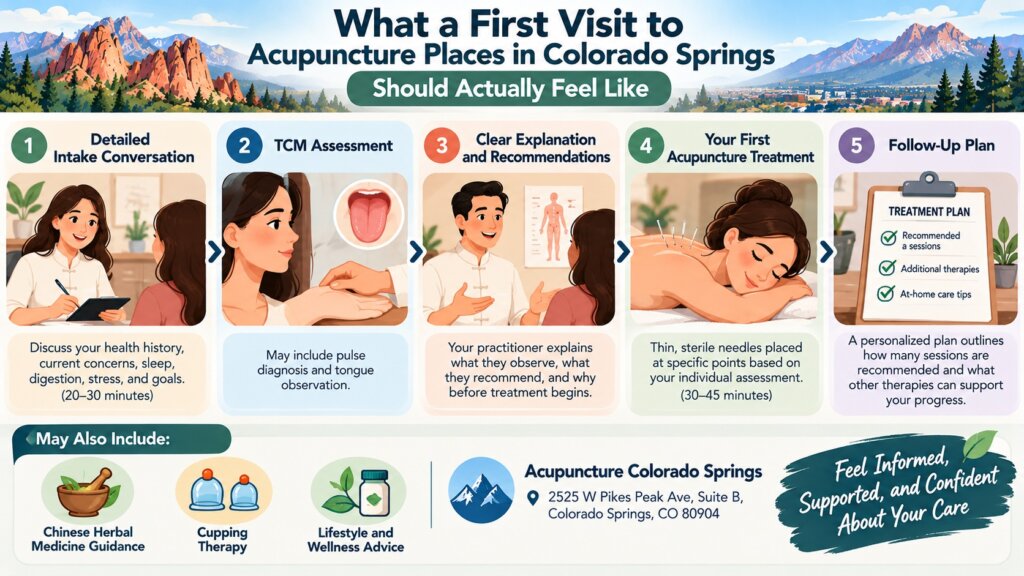
A first appointment at a quality acupuncture clinic should not feel rushed or transactional. You should leave knowing more about your own health than when you walked in. That is the standard we hold ourselves to at Acupuncture Colorado Springs, and it is a reasonable expectation for any acupuncture place you consider.
Here is what a well-structured first visit typically includes:
- A detailed intake conversation covering your health history, current concerns, sleep, digestion, stress levels, and goals—usually 20 to 30 minutes.
- A Traditional Chinese Medicine assessment that may include pulse diagnosis and tongue observation, which give the practitioner insight into your internal patterns.
- A clear explanation of what the practitioner observes, what they recommend, and why—before treatment begins.
- Your first acupuncture treatment, which typically lasts 30 to 45 minutes and involves thin, sterile acupuncture needles placed at specific points based on your individual assessment.
- A follow-up plan that outlines how many sessions are recommended, what complementary therapies might support your progress, and what you can do between visits.
You might also receive recommendations for Chinese herbal medicine guidance or cupping therapy as part of your ongoing care. These are not add-ons for revenue—they are tools that, when used appropriately, can accelerate and deepen the results of acupuncture treatment. If you are curious about what this looks like in practice, our services page walks through each option in detail.
Why Acupuncture Places That Go Beyond the Acupuncture Mat Deliver Better Results
There is a growing consumer market around acupuncture-adjacent tools—acupuncture mats, pressure point rollers, and at-home stimulation devices. These products have their place, and some people find them helpful for relaxation or mild tension relief. But an acupuncture mat is not acupuncture. It does not involve trained needle placement, diagnostic assessment, or individualized point selection. The gap between a wellness product and a clinical treatment is significant.
When you are choosing between acupuncture places in Colorado Springs, look for a clinic that offers real clinical depth—not just a comfortable room and a pleasant atmosphere. The NCCIH is clear that acupuncture’s effectiveness for conditions like chronic pain depends on the skill and training of the practitioner, not just the presence of needles or needle-like tools. That distinction matters when you are dealing with something that has not responded to other approaches.
Our practice at Acupuncture Colorado Springs goes well beyond surface-level treatment. We look at your full health picture, design a care plan that fits your life and goals, and adjust that plan as you progress. If you are in Colorado Springs or the surrounding El Paso County communities—Manitou Springs, Old Colorado City, Woodland Park—and you are ready to work with a practitioner who takes your health seriously, we would be glad to be part of that process. Book an appointment or reach out to us to get started.
Local Considerations for Colorado Springs Residents
The high-altitude, dry climate of the Pikes Peak region affects everything from respiratory health to skin hydration to how quickly the body recovers from physical exertion. Seasonal changes bring their own challenges, from winter dryness and cold-related pain to spring allergies and summer heat exhaustion. Practitioners familiar with these local factors can tailor treatment recommendations to address altitude-related fatigue, dehydration, seasonal transitions, and the physical demands of Colorado’s active outdoor lifestyle.
Conclusion
Choosing among acupuncture places in Colorado Springs means looking past ratings and into what actually shapes your care. Credentials, needle safety, personalized treatment, and a practitioner who understands your local lifestyle are what move the needle on long-term results. Acupuncture Colorado Springs, led by David W. Armstrong, L.Ac., is built around exactly those standards—and we are here when you are ready to take that step.
Acupuncture Colorado Springs pairs board-certified expertise with personalized, root-cause-focused care that goes beyond surface symptoms. David W. Armstrong, L.Ac. designs every treatment plan around your unique health goals. Get started today by booking your first appointment.
FAQs
How Much Does Acupuncture Usually Cost?
Acupuncture pricing varies by clinic, visit length, and what’s included (e.g., cupping, therapeutic massage, or herbal guidance). In Colorado Springs, most people can expect a higher first-visit rate for the longer intake and a lower rate for follow-ups. A reputable clinic should clearly explain fees up front and recommend a plan based on your goals—not a one-size-fits-all package.
Is Acupuncture Covered by Insurance?
Sometimes. Coverage depends on your specific plan and whether acupuncture is included for your condition (often pain-related concerns). Many patients use HSA/FSA funds, and some plans reimburse out-of-network care. The simplest approach is to call your insurer and ask about acupuncture benefits, visit limits, and any referral requirements.
How Do I Choose a Good Acupuncture Clinic?
Look beyond reviews and confirm the provider is licensed and board-certified, uses sterile single-use needles, and takes time to understand your health history. A strong clinic will explain their approach, set realistic expectations, and tailor treatment to root causes—not just symptoms. Comfort, communication, and a clean, calm environment also matter.
What Should I Expect at My First Acupuncture Appointment?
Your first visit typically includes a detailed conversation about your symptoms, medical history, lifestyle, and goals, followed by a personalized treatment. You’ll rest with very thin, sterile needles placed at specific points, and some clinics may add techniques like cupping or gentle bodywork when appropriate. Most people feel relaxed afterward, and you’ll usually leave with a clear plan for next steps.
How Many Acupuncture Sessions Do You Need To See Results?
It depends on what you’re treating, how long it’s been going on, and your overall health. Some people notice changes after 1–3 sessions, while longer-standing or complex issues often need a series of visits for more lasting improvement. A skilled practitioner will reassess progress regularly and adjust your care plan based on your response.