
Arthritis flare-ups can stop you in your tracks. The swelling, heat, and sharp pain that come with a flare make even simple tasks feel impossible—and the last thing you want is to make things worse. So when someone suggests acupuncture during a flare-up, it is natural to pause and wonder: is that actually a good idea?
This article breaks down what arthritis acupuncture really involves during active flare-ups, what the research says about timing and safety, how rheumatoid arthritis acupuncture differs from osteoarthritis care, and when treatment is appropriate versus when it is better to wait. You will also learn how a personalized, root-cause approach to acupuncture arthritis care can support your long-term joint health—not just mask symptoms.
Key Takeaways
- Arthritis acupuncture during flare-ups may be appropriate depending on flare severity, joint location, and your overall health picture.
- Research from the NCCIH supports acupuncture as a complementary approach for reducing arthritis-related pain and improving function.
- Rheumatoid arthritis acupuncture requires extra care during active inflammatory episodes, and treatment should always be guided by a licensed practitioner.
- Acupuncture for lower back pain and joint stiffness is among the most evidence-supported uses of this therapy in arthritis management.
- A qualified acupuncturist will assess your flare before needling—never applying treatment blindly to inflamed tissue.
- Personalized care plans, not generic protocols, are what produce meaningful and lasting results for arthritis patients.
Arthritis Acupuncture During Flare-Ups: What You Need to Know First
The question of whether arthritis acupuncture is appropriate during a flare-up does not have a simple yes or no answer. It depends on the type of arthritis you have, how intense the flare is, which joints are involved, and what your practitioner observes during your intake assessment. What works during a mild osteoarthritis flare in the knee may not be the right approach during a severe rheumatoid arthritis episode affecting multiple joints.
That said, acupuncture is not automatically off the table when a flare hits. In many cases, carefully applied needling away from the most inflamed areas can help calm the nervous system, reduce systemic inflammation signals, and offer meaningful pain relief without aggravating the affected joint. The key word there is carefully.
Timing matters. A skilled practitioner reads your body—not just your diagnosis.
According to the National Center for Complementary and Integrative Health (NCCIH), acupuncture has shown promise for reducing pain and improving physical function in people with osteoarthritis, particularly of the knee. Studies on rheumatoid arthritis acupuncture are more limited but suggest potential benefits for pain modulation and quality of life when used alongside conventional treatment.
Understanding Arthritis Flare-Ups and How Acupuncture Arthritis Care Responds

A flare-up is not just increased pain—it is a period of heightened inflammatory activity in the joint tissue. For rheumatoid arthritis patients, this means the immune system is actively attacking joint linings, causing redness, warmth, swelling, and stiffness that can last days or even weeks. For osteoarthritis patients, a flare often involves cartilage stress, localized swelling, and acute sensitivity around the joint.
Acupuncture arthritis care approaches these two scenarios differently. With rheumatoid arthritis, the goal during a flare is often systemic—calming the inflammatory response, supporting immune regulation, and reducing pain through distal points rather than needling directly into hot, swollen tissue. With osteoarthritis, gentle local treatment may still be appropriate depending on the severity of the flare.
You might be wondering: does needling near an inflamed joint make things worse? In the hands of an experienced practitioner, the answer is generally no—but the practitioner must make that call in real time, based on what they observe, not what a protocol says.
When Arthritis Acupuncture Is Appropriate During a Flare-Up
There are clear situations where acupuncture arthritis treatment can be both safe and helpful during an active flare. Equally, there are situations where it is better to wait, modify the approach, or coordinate with your rheumatologist before proceeding. The table below offers a practical overview.
| Situation | Acupuncture Approach | Notes |
|---|---|---|
| Mild osteoarthritis flare, one joint | Gentle local and distal needling may be appropriate | Practitioner assesses heat and swelling first |
| Moderate rheumatoid arthritis flare | Distal points, systemic calming, avoid inflamed joints | Coordinate with rheumatologist if on biologics |
| Severe multi-joint RA flare | Consider delaying local needling; focus on stress and systemic support | Acupuncture lower back or distal points may still help |
| Arthritis-related lower back pain flare | Acupuncture lower back treatment often appropriate | Strong evidence base for this application |
| Acupuncture for costochondritis flare | Gentle chest and adjacent point work; avoid direct rib pressure | Confirm diagnosis before treatment |
This is not a checklist you apply on your own. It is a framework your acupuncturist uses to make an informed clinical decision at your appointment.
What Research Says About Rheumatoid Arthritis Acupuncture and Pain Relief
The evidence base for arthritis acupuncture has grown meaningfully over the past two decades. The NCCIH notes that for osteoarthritis of the knee, acupuncture has demonstrated statistically significant improvements in pain and physical function compared to sham acupuncture and standard care alone. These findings are not fringe—they come from well-designed clinical trials that have informed how integrative medicine practitioners approach joint pain today.
For rheumatoid arthritis acupuncture specifically, a 2025 systematic review published in PMC found that acupuncture may help reduce pain scores and improve morning stiffness in RA patients, though researchers note the need for larger, longer-duration trials. What the current evidence does support is that acupuncture is unlikely to cause harm when administered by a trained practitioner—and that it may offer meaningful adjunctive benefit for people managing chronic inflammatory arthritis.
The NCCIH also highlights acupuncture as one of the more evidence-supported complementary approaches for low back pain, which frequently overlaps with arthritis presentations. For patients dealing with both arthritis lower back pain and referred leg symptoms that mimic acupuncture for sciatica patterns, a skilled TCM assessment can identify whether the root cause is spinal arthritis, nerve involvement, or a combination of both.
How Acupuncture Colorado Springs Approaches Arthritis Flare-Up Care
At Acupuncture Colorado Springs, led by David W. Armstrong, L.Ac., no two arthritis patients are treated the same way—and that is especially true during flare-ups. Every appointment begins with a thorough intake conversation about your current symptoms, flare history, medications, and how your body has been responding to treatment. That conversation shapes everything that follows.
During a flare, David may choose to work entirely with distal acupuncture points—areas of the body far from the inflamed joint—that influence pain signaling and inflammation through the nervous system. This approach allows the body to receive the calming, regulatory effects of acupuncture without any direct stimulation of irritated tissue. In some cases, gentle cupping therapy away from inflamed areas or Chinese herbal medicine guidance may also be incorporated to support the body’s natural response to inflammation.
If you are managing rheumatoid arthritis, osteoarthritis of the knee or hip, acupuncture for costochondritis, or arthritis-related acupuncture lower back pain, our clinic can work alongside your existing medical care—not replace it. We use sterile, single-use needles in full compliance with Colorado state licensing requirements, and we take the time to explain every step of your treatment so you always know what is happening and why.
Ready to explore whether arthritis acupuncture is right for your current flare? book-appointment”>Schedule a consultation with our clinic and let us build a plan that fits where you are right now.
Practical Steps: What to Expect When Seeking Acupuncture Arthritis Care During a Flare
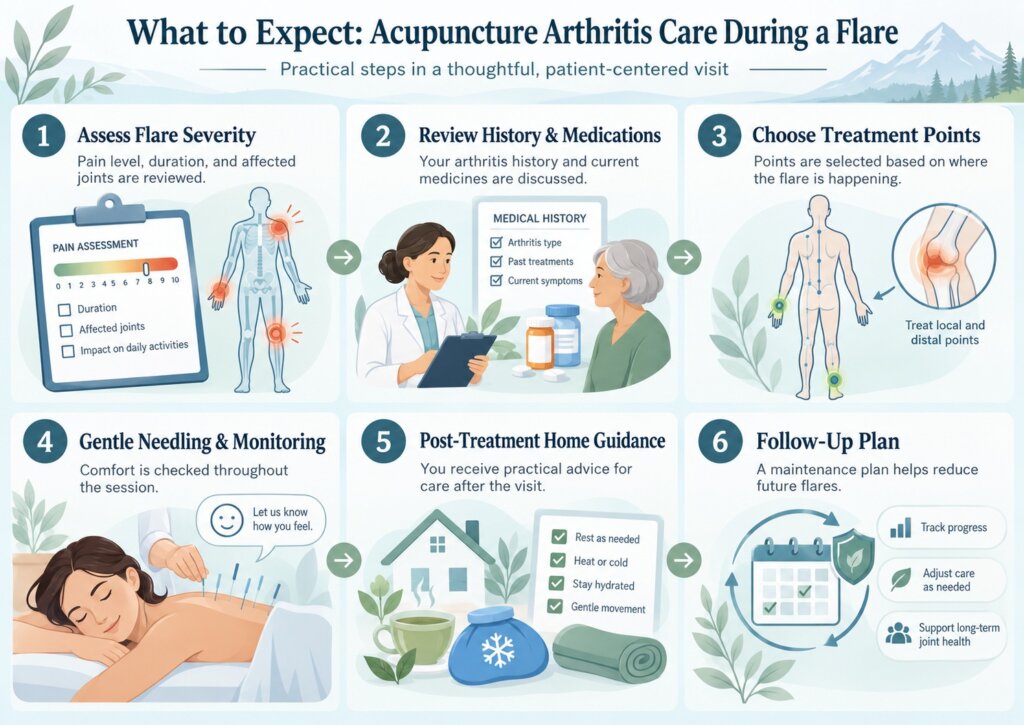
Walking into an acupuncture appointment during a painful flare can feel uncertain. Here is what a thoughtful, patient-centered process actually looks like when you come to our clinic during an active episode.
1. Initial Assessment of Your Flare Severity
Your practitioner will ask detailed questions about how long the flare has been active, which joints are affected, and what your pain level is on a functional scale. This is not a formality—it directly determines whether and how needling proceeds that day.
2. Review of Your Arthritis History and Current Medications
Knowing whether you are on DMARDs, biologics, corticosteroids, or NSAIDs helps your acupuncturist understand your body’s current state and avoid any interactions or contraindications. This step is especially important for rheumatoid arthritis acupuncture patients.
3. Selection of Treatment Points Based on Flare Location
If your knee is acutely inflamed, needling may focus on distal points along the stomach, spleen, or gallbladder meridians rather than directly at the knee. If your flare involves acupuncture lower back patterns, targeted lumbar and sacral points may be used with care.
4. Gentle Needling With Real-Time Monitoring
During the session, your practitioner checks in with you regularly. Acupuncture should never feel sharp, burning, or distressing. Any discomfort beyond a mild ache or tingling sensation is communicated and adjusted immediately.
5. Post-Treatment Guidance for Flare Management
After your session, you will receive practical advice on what to do at home—whether that involves heat or cold application, rest recommendations, or herbal support options that complement your treatment. Our clinic does not hand you a pamphlet and send you on your way.
6. Follow-Up Planning to Prevent Future Flares
One session during a flare is not a long-term strategy. We work with you to build a maintenance schedule that addresses the underlying patterns contributing to your flares—whether that is stress, sleep disruption, diet, or systemic inflammation that keeps cycling back.
Arthritis Acupuncture and Overlapping Conditions: Sciatica, Costochondritis, and Lower Back Pain
Arthritis rarely travels alone. Many patients who come in for acupuncture arthritis care are also managing overlapping conditions that complicate the picture. Acupuncture for sciatica, for example, is a common need among patients whose lumbar arthritis has narrowed the spinal canal and put pressure on the sciatic nerve. The pain pattern feels different from typical joint pain—it radiates down the leg, sometimes reaching the foot—but arthritis is often the underlying driver.
Acupuncture for costochondritis is another area where patients with inflammatory arthritis sometimes seek care. Costochondritis, inflammation of the cartilage connecting the ribs to the sternum, can flare alongside systemic arthritis and cause chest pain that is easy to misread. Gentle acupuncture work in the thoracic region and adjacent meridian points may help reduce local inflammation and ease breathing discomfort during a flare.
Acupuncture lower back treatment remains one of the most well-researched applications in this field. The NCCIH identifies it as a complementary approach with meaningful evidence for reducing pain and improving function—making it a valuable part of any arthritis care plan that involves spinal involvement.
Our clinic assesses all of these presentations together, not in isolation. If your lower back, ribs, and knee are all involved, we look at the full pattern—not just the loudest symptom.
Supporting Long-Term Joint Health Beyond the Flare
Getting through a flare is one goal. Reducing how often flares happen—and how severe they are when they do—is the longer game. Arthritis acupuncture, when used consistently as part of a broader care plan, may help regulate the inflammatory cycles that drive recurring flares in both osteoarthritis and rheumatoid arthritis patients.
At our clinic, we often combine acupuncture sessions with Chinese herbal medicine guidance to support joint tissue, improve circulation, and address the stress patterns that frequently trigger inflammatory episodes. Colorado Springs’ dry, high-altitude climate can also affect joint hydration and tissue recovery—something we factor into care plans for local patients who are active outdoors year-round.
If you have been cycling through flares without a clear strategy for breaking the pattern, explore our full range of holistic services and see how an integrated approach might give your body the consistent support it needs to heal more deeply between episodes.
Closing Thoughts on Arthritis Acupuncture During Flare-Ups
Arthritis acupuncture during a flare-up can be appropriate, safe, and genuinely helpful—when it is guided by a skilled practitioner who assesses your specific situation before picking up a needle. The research supports its role in pain reduction and functional improvement, and a personalized approach ensures your treatment fits your body, your flare, and your long-term goals. If you are in Colorado Springs and ready to find out whether acupuncture arthritis care is right for where you are today, our clinic is here to help you take that next step with clarity and confidence.
Acupuncture Colorado Springs offers board-certified acupuncture care tailored to arthritis flare-up relief. David W. Armstrong, L.Ac. builds personalized treatment plans targeting root causes. Get started today by booking your consultation.
FAQs
Does Acupuncture Really Help Arthritis?
Acupuncture can help many people with arthritis by reducing pain, easing stiffness, and improving function—especially when used alongside appropriate medical care, movement, and lifestyle support. Results vary by arthritis type, flare severity, and overall health, so we tailor treatment based on your patterns and goals.
What Is the Best Acupuncture Point for Arthritis?
There isn’t one “best” point for arthritis because effective treatment depends on which joints are involved, the quality of the pain, swelling, and your underlying constitution. We typically combine local points near the affected joint with distal points that support circulation, pain modulation, and systemic balance.
How Many Acupuncture Sessions Are Needed for Arthritis?
Many patients start noticing changes within 3–6 visits, but longer-standing arthritis often does best with a short initial series (commonly 6–10 treatments) followed by a maintenance plan. During flare-ups, sessions may be closer together at first, then spaced out as symptoms stabilize.
Can Acupuncture Reduce Inflammation in Arthritis?
Acupuncture may help downshift inflammatory activity and calm pain signaling, which can translate into less swelling and improved comfort for some patients. We also often discuss evidence-informed lifestyle and Chinese medicine strategies that can further support a healthier inflammatory response.
Is Acupuncture Safe for People With Arthritis?
Yes—when performed by a licensed practitioner using sterile, single-use needles, acupuncture is generally very safe for people with arthritis. We adjust techniques during flare-ups, around sensitive joints, and for anyone on blood thinners or with complex medical histories to keep care comfortable and appropriate.