Morning joint stiffness is one of those things that sneaks up on you. You wake up, try to move, and your knees, fingers, or hips feel like they need ten minutes just to remember how to work. For many people in Colorado Springs—especially those managing arthritis, age-related wear, or the physical demands of an active outdoor lifestyle—this kind of stiffness is a daily frustration that medication alone doesn’t always fully address.
This article walks you through what acupuncture can realistically do for morning joint stiffness, how long acupuncture takes to produce noticeable results, what a typical treatment timeline looks like, and what factors influence how quickly your body responds. You’ll also learn how long an acupuncture session lasts, what needles are used, and when it might make sense to reach out to a licensed practitioner near you.
Key Takeaways
- Most patients begin noticing changes in joint stiffness after four to six acupuncture sessions, though individual timelines vary.
- A standard acupuncture session lasts between 45 and 90 minutes, with the needle treatment portion typically running 30 to 40 minutes.
- Acupuncture has been used as a therapeutic practice for roughly 2,500 years, with a growing body of modern research supporting its use for pain and inflammation.
- How long acupuncture needles are depends on the treatment area, with clinical studies commonly citing lengths of 25 to 50 mm for most body points.
- Root-cause assessment, lifestyle factors, and the severity of joint involvement all influence how long acupuncture takes to show results.
- Acupuncture Colorado Springs offers personalized care plans designed around your specific pattern of stiffness, not a generic protocol.
How Long Does Acupuncture Take to Help With Morning Joint Stiffness?
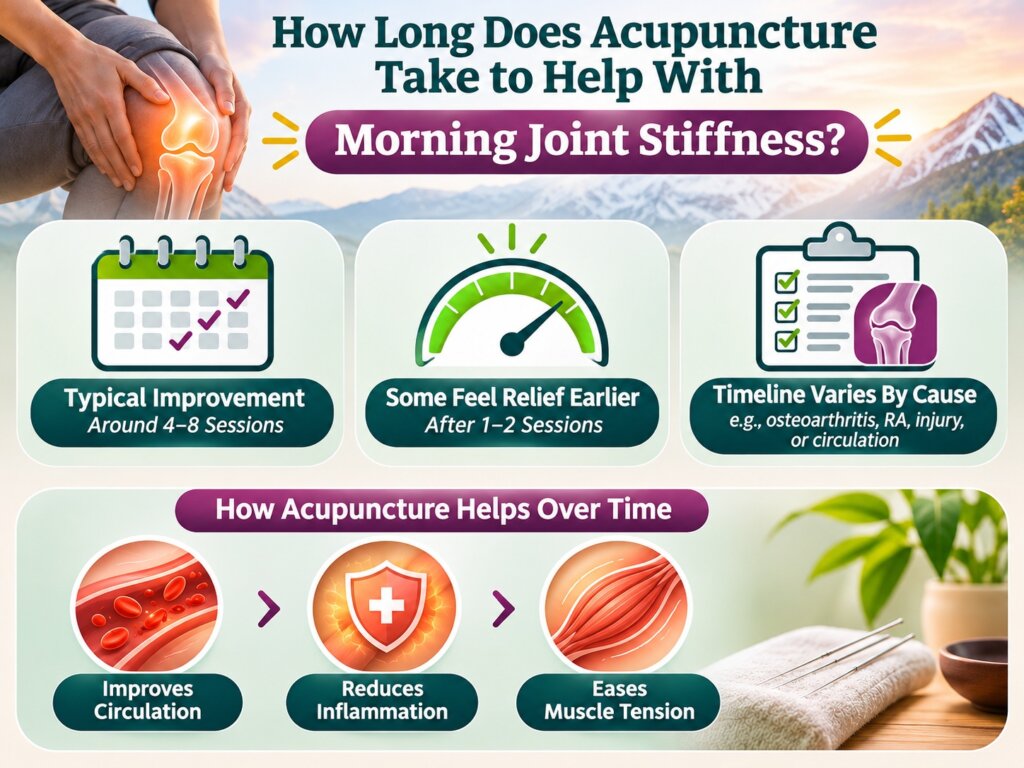
This is probably the first question most people ask, and it deserves a straight answer. For morning joint stiffness specifically, most patients who commit to a consistent care plan begin to notice meaningful changes somewhere between their fourth and eighth session. That said, some people feel a shift in circulation and ease of movement after just one or two visits—particularly when stiffness is related to tension, cold, or stress rather than deep structural joint damage.
The honest answer is that acupuncture how long it takes depends on what’s driving your stiffness. Stiffness from early-stage osteoarthritis responds differently than stiffness from rheumatoid arthritis, post-injury inflammation, or simply poor circulation from Colorado’s cold mornings and high-altitude dry air. A licensed acupuncturist will assess your pattern before estimating a timeline.
What most practitioners agree on is this: acupuncture is not a one-session fix. It works cumulatively. Each session builds on the last, gradually encouraging your body’s own regulatory systems to reduce inflammation, improve local blood flow, and ease the tension that contributes to that locked-up feeling first thing in the morning.
How Long Has Acupuncture Been Around, and Why Does That Matter for Joint Health?
You might be wondering whether acupuncture is backed by more than tradition. According to the World Health Organization, acupuncture has been practiced throughout the Chinese-cultural region for roughly 2,500 years—making it one of the oldest continuously used therapeutic systems in human history. That kind of longevity doesn’t happen by accident.
Over those centuries, practitioners developed detailed maps of the body’s acupuncture points and refined techniques for addressing pain, stiffness, and systemic imbalance. In Traditional Chinese Medicine, morning joint stiffness is often associated with what’s called a Bi syndrome pattern—essentially, an obstruction of Qi and blood flow through the joints, frequently worsened by cold and dampness. Sound familiar? Colorado Springs winters and early mornings can be exactly that kind of environment.
Modern research has added a different layer of understanding. Studies suggest acupuncture may stimulate the release of endorphins, reduce pro-inflammatory markers, and improve microcirculation in affected tissues. These mechanisms offer a plausible explanation for why patients with joint stiffness often report feeling more mobile after a course of treatment.
How Long Does an Acupuncture Session Last, and What Happens During It?
If you’ve never had acupuncture before, you might picture something quick—in and out in fifteen minutes. The reality is more involved, and that’s a good thing. According to the Mayo Clinic, an acupuncture session may take up to 60 minutes, though some appointments are shorter depending on the treatment focus. The Cleveland Clinic notes that an initial evaluation and treatment can take up to a full hour, with follow-up sessions typically running 45 to 60 minutes and needles retained for at least 20 minutes.
Healthline reports that some sessions, particularly comprehensive ones, can run 60 to 90 minutes, with the actual needle treatment portion lasting around 30 to 40 minutes. The rest of the time involves intake, assessment, and post-treatment rest.
Here’s a general breakdown of what to expect during a session focused on joint stiffness:
- Health intake and assessment (10–20 minutes): Your practitioner asks about your stiffness pattern, when it’s worst, what makes it better or worse, your sleep, digestion, and stress levels. This is not small talk—it’s diagnostic.
- Point selection and needle placement (5–10 minutes): Needles are placed at specific acupuncture points, which may be near the affected joints or at distal points that influence the same energy channels.
- Needle retention (20–40 minutes): You rest quietly while the needles work. Many patients fall asleep during this phase.
- Removal and post-treatment guidance (5–10 minutes): Needles are removed, and your practitioner may suggest stretches, heat application, or herbal support between sessions.
At Acupuncture Colorado Springs, every session starts with a real conversation about where you are that day—because joint stiffness doesn’t always show up the same way twice. David W. Armstrong, L.Ac., adjusts point selection based on your current presentation, not a fixed template.
How Long Are Acupuncture Needles, and Is the Process Uncomfortable?
This is one of the most common concerns people bring up before their first session. Acupuncture needles are not the same as the needles used for injections or blood draws. They’re extremely thin—closer in diameter to a strand of hair than a hypodermic needle—and the sensation is quite different from what most people expect.
According to recent clinical research published in peer-reviewed literature, acupuncture needles commonly used in practice range from about 25 to 50 mm in length, though the depth of insertion is typically only a few millimeters to a centimeter depending on the body area. Specialized longer needles, sometimes 75 mm or more, may be used for deeper muscle tissue in areas like the hip or thigh.
For joint stiffness in the hands, knees, or feet, shorter needles at shallower depths are standard. Most patients describe the sensation as a mild ache, warmth, or slight pressure at the needle site—not sharp pain. Many people are surprised by how relaxed they feel once the needles are in place.
We use only sterile, single-use needles at our clinic, in full compliance with Colorado state licensing and hygiene regulations. There is no reuse, no shortcuts.
What Factors Influence How Long Acupuncture Takes to Work for Joint Stiffness?
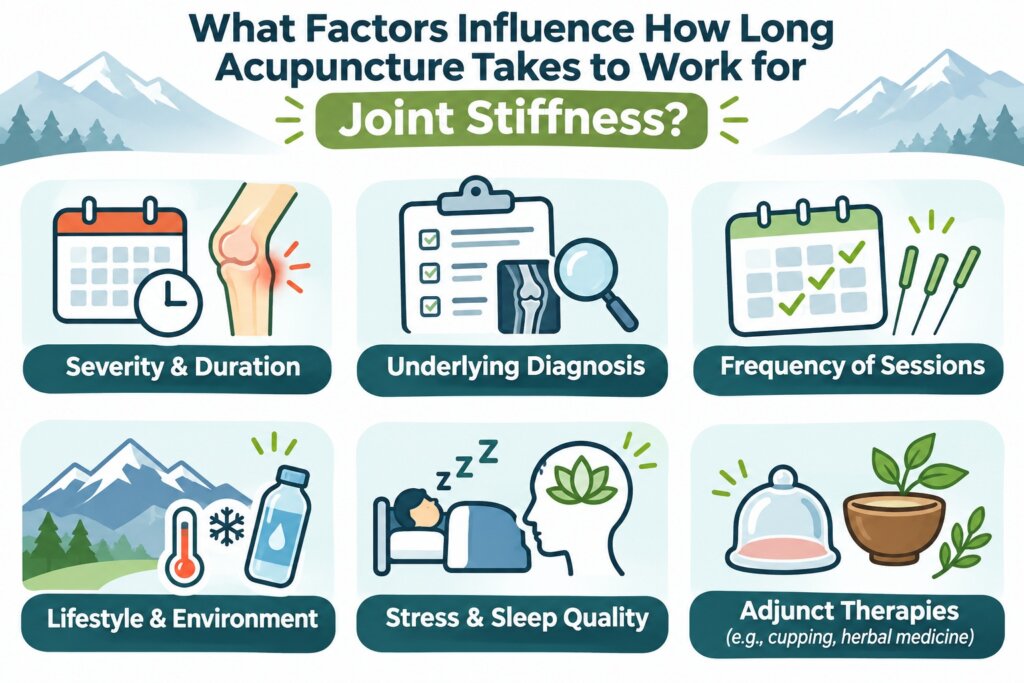
Not everyone responds to acupuncture on the same timeline, and it helps to understand why. Several variables shape how quickly—or gradually—you might notice improvement in morning joint stiffness.
1. Severity and Duration of the Stiffness
Stiffness that has been present for years tends to take longer to shift than stiffness that developed more recently. Chronic patterns are more deeply established in the body’s tissue and nervous system response.
2. Underlying Diagnosis
Osteoarthritis, rheumatoid arthritis, fibromyalgia, and post-surgical stiffness each have different root causes. Acupuncture addresses these differently, and the timeline reflects that complexity.
3. Frequency of Sessions
Patients who come in once or twice a week during an initial care phase typically see faster progress than those who schedule sessions only occasionally. Consistency matters more than intensity in the early stages.
4. Lifestyle and Environment
In Colorado Springs, cold mornings, dry air, and altitude all affect joint health. If you’re spending long hours in the cold or not staying well-hydrated at elevation, those factors can slow your body’s response to treatment. Your practitioner may offer guidance on how to support your sessions between visits.
5. Stress and Sleep Quality
Chronic stress raises cortisol, which contributes to systemic inflammation. Poor sleep limits the body’s repair processes. Both factors can slow acupuncture’s cumulative effect on joint stiffness. This is one reason we often address stress and sleep alongside joint pain in the same care plan.
6. Adjunct Therapies
Combining acupuncture with cupping therapy or Chinese herbal medicine guidance can support faster and more sustained results. Cupping, for example, may help improve circulation in stiff areas between needle sessions. Our clinic offers both as part of a coordinated care approach.
A Realistic Treatment Timeline for Morning Joint Stiffness
Setting honest expectations is part of good care. Here’s a general framework based on clinical experience and what research suggests about acupuncture treatment timelines for joint-related conditions.
| Phase | Sessions | What to Expect |
|---|---|---|
| Initial Phase | Sessions 1–3 | Assessment, baseline treatment, possible mild soreness or fatigue after sessions |
| Response Phase | Sessions 4–8 | Many patients begin noticing reduced stiffness duration or intensity in the morning |
| Consolidation Phase | Sessions 9–12 | Improvements stabilize; practitioner may begin spacing sessions further apart |
| Maintenance Phase | Monthly or as needed | Ongoing support to prevent regression, especially during cold seasons or high-stress periods |
This timeline is a guide, not a guarantee. Some patients move through phases faster. Others need more time, especially if multiple joint areas are involved or if there are overlapping health concerns like autoimmune activity or significant inflammation.
If you’re curious about where you might fall on this timeline, a consultation with David W. Armstrong, L.Ac., at Acupuncture Colorado Springs is a good starting point. We take the time to review your history, assess your pattern, and give you an honest picture of what to expect—before you commit to anything.
When to Consider Acupuncture for Your Joint Stiffness
You don’t have to be in severe pain to benefit from acupuncture. Many patients come in when stiffness is manageable but persistent—when it’s affecting their morning routine, their ability to hike or garden, or their quality of sleep. Earlier intervention tends to produce faster results.
If you’ve already tried physical therapy, anti-inflammatory medications, or lifestyle changes with limited success, acupuncture may offer a different angle of approach. It doesn’t replace other care, but it can work alongside it. We coordinate with patients’ other healthcare providers when appropriate.
Patients from across El Paso County—including Manitou Springs, Old Colorado City, and Woodland Park—visit our clinic specifically because they want care that goes beyond symptom management. They want someone to look at the whole picture. That’s exactly what we do.
If you’re ready to explore whether acupuncture is a good fit for your morning joint stiffness, we invite you to schedule a consultation at our Colorado Springs clinic. There’s no pressure, no generic pitch—just a real conversation about your health and what’s possible.
Wrapping Up What You Need to Know
Morning joint stiffness responds well to acupuncture when treatment is consistent, personalized, and grounded in a clear understanding of what’s driving your symptoms. Most people begin to notice meaningful change within four to eight sessions, with each visit building on the last. The process takes time, but for many patients, it’s time well spent—especially when the alternative is waking up stiff every morning for years to come.
Acupuncture Colorado Springs offers personalized, root-cause acupuncture care for joint stiffness. Board-certified practitioner David W. Armstrong designs treatment plans tailored to your body. Get started today—call our Colorado Springs clinic and feel the difference.
FAQs
How Long Does It Take for Acupuncture to Start Working?
Some people notice changes after the first visit (often within 24–72 hours), while others need a few treatments before morning joint stiffness improves. At Acupuncture Colorado Springs, we tailor your plan based on the root causes we find—like inflammation patterns, stress load, sleep quality, and recovery capacity—so progress is steady and measurable.
How Many Acupuncture Sessions Does It Take to See Results?
For morning joint stiffness, many patients feel meaningful improvement within 3–6 sessions, though longer-standing or more complex issues may take 8–12+ sessions. We typically reassess after a short initial series and adjust your care plan to match your response and goals.
How Long Do Acupuncture Results Last?
Results can last from several days to several weeks, depending on how long the stiffness has been present, your activity level, and underlying drivers like inflammation, stress, or overuse. With consistent care and supportive recommendations (such as targeted self-care and evidence-informed lifestyle changes), benefits often last longer and become more stable over time.
How Long Does an Acupuncture Session Take?
Most appointments last about 45–60 minutes, including check-in and treatment time. Needle retention is commonly 20–35 minutes, and sessions may also include cupping or therapeutic bodywork when appropriate.
How Often Should You Get Acupuncture for Best Results?
For best results with morning joint stiffness, many people start with 1–2 visits per week for a few weeks, then taper to weekly or every other week as symptoms improve. We personalize frequency based on how quickly you respond, how persistent the stiffness is, and what will be most sustainable for long-term relief.