If you take blood thinners or have a bleeding disorder, you may have questions about whether acupuncture is safe for you. That concern is completely reasonable. Acupuncture involves inserting thin needles into specific acupuncture points on the body, and any time the skin is pierced, bleeding risk becomes a real clinical consideration. The good news is that acupuncture and pain management can still work together safely for many people—when the right screening steps are followed.
This article covers the key acupuncture contraindications related to blood thinners and bleeding risks. You will learn what conditions require extra caution, which situations may prevent treatment altogether, and how a qualified practitioner approaches these decisions. We will also explain how individualized care planning at our clinic helps patients in Colorado Springs receive safe, effective treatment even when their health history is complex.
Key Takeaways
- Acupuncture contraindications related to bleeding are divided into absolute and relative categories, and each patient requires individual risk assessment.
- Patients on anticoagulant medications like warfarin or heparin are considered a relative contraindication, not an automatic disqualification from care.
- Certain acupuncture points and needle depths carry higher bleeding risk and must be avoided or modified in anticoagulated patients.
- Uncontrolled bleeding disorders represent an absolute contraindication where acupuncture should not proceed.
- A thorough health history intake before your first session is the most important safety step a practitioner can take.
- Acupuncture benefits for pain, stress, and inflammation can still be accessible to many patients on blood thinners with proper clinical judgment.
Acupuncture Contraindications for Blood Thinners and Bleeding Risks Explained
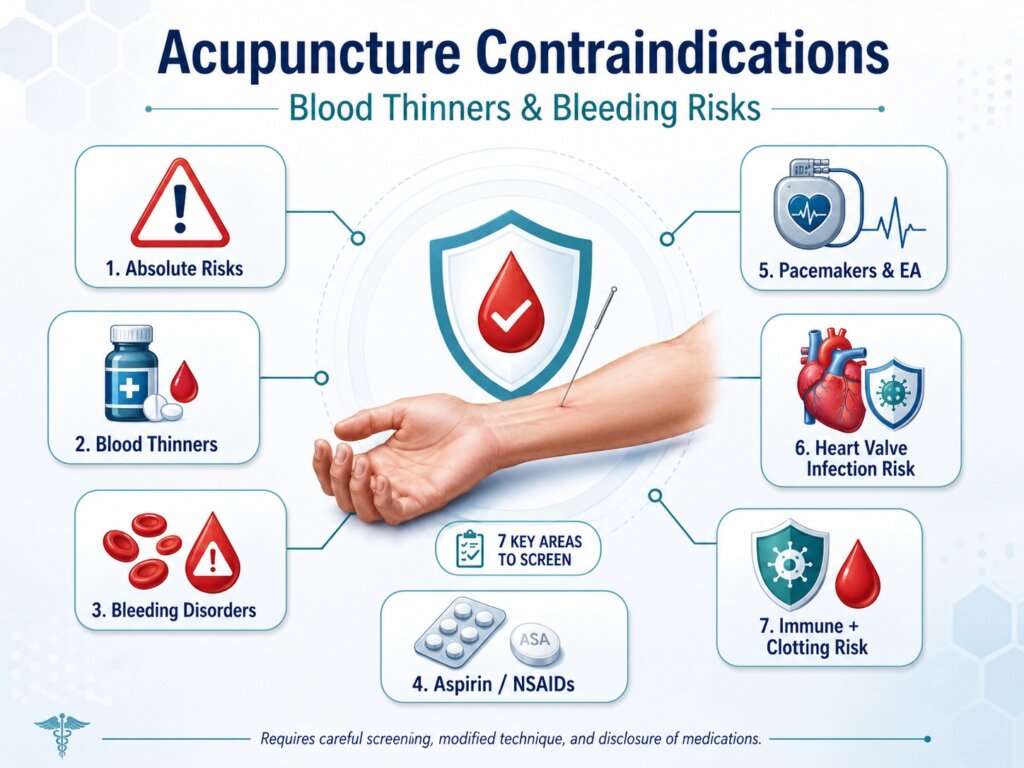
When people ask about acupuncture contraindications, blood thinners and bleeding disorders come up frequently—and for good reason. Anticoagulant medications like warfarin, heparin, rivaroxaban, and apixaban reduce the blood’s ability to clot, which means even a small needle insertion carries a higher chance of bruising, prolonged bleeding, or hematoma formation at the needle site. This does not mean acupuncture is off the table, but it does mean the clinical picture needs careful review before any needles are placed.
According to StatPearls via the National Institutes of Health, there are very few strict contraindications to acupuncture overall. Most practitioners focus on avoiding treatment in cases of active infection, malignancy at the needling site, or severe neutropenia. Blood thinners fall into a category that requires caution and modified technique rather than outright avoidance in most cases.
The distinction between absolute and relative contraindications matters here. Physio-Pedia and the AACP classify uncontrolled bleeding disorders as a condition requiring individual risk-benefit assessment, while intracapsular joint points in anticoagulated patients are listed as an absolute contraindication. That means a practitioner should not needle directly into a joint capsule if you are on blood thinners, but surface-level needling at appropriate acupuncture points may still be appropriate with care.
1. Absolute Contraindications Involving Bleeding Risk
An absolute contraindication means acupuncture should not be performed under any circumstance related to that condition. For bleeding specifically, this applies to patients with uncontrolled bleeding disorders where the risk of hemorrhage cannot be managed safely. It also applies to intracapsular acupuncture points in patients who are actively anticoagulated, as confirmed by Physio-Pedia’s clinical guidelines.
Open wounds, active skin infections, and recent surgical sites also fall into absolute contraindication territory. Needling through compromised tissue introduces infection risk and can disrupt healing.
2. Relative Contraindications: Anticoagulant Medications
Patients taking anticoagulants like warfarin, eliquis, or xarelto are classified as a relative contraindication. This means acupuncture may still be appropriate, but the decision requires a thorough review of your current INR levels, dosage, and overall bleeding history. A PubMed-reviewed overview of acupuncture complications confirms that coagulation disorders are among the key concerns requiring pre-treatment screening, particularly in pain management contexts.
In practice, this often means your practitioner will choose acupuncture points away from areas with dense vasculature, use finer gauge needles, and apply gentle pressure after needle removal to reduce bruising.
3. Relative Contraindications: Platelet Disorders and Hemophilia
Conditions like hemophilia, thrombocytopenia, or von Willebrand disease affect how your blood clots at a physiological level rather than through medication. These present similar clinical concerns to anticoagulant use but may carry higher unpredictability. A practitioner needs to know your current platelet count and any recent lab work before proceeding.
For patients with managed platelet disorders who want to explore acupuncture benefits for pain or stress, working with both your hematologist and your acupuncturist is the safest path forward.
4. Aspirin and NSAIDs: A Lower-Level Concern
Low-dose aspirin and non-steroidal anti-inflammatory drugs like ibuprofen also affect platelet function, though less severely than prescription anticoagulants. Most trained practitioners consider these a minimal concern for standard acupuncture sessions. You might be wondering whether your daily aspirin should stop you from booking an appointment—in most cases, the answer is no, but disclosure is still important.
Transparency about all medications, including over-the-counter options, allows your practitioner to make informed decisions about needle placement and technique.
5. Electroacupuncture and Pacemakers or AICDs
Electroacupuncture—a technique that passes a mild electrical current between needles—carries its own contraindication profile. StatPearls notes that caution is advised when electroacupuncture is used in patients with pacemakers or implantable cardioverter-defibrillators. This is not directly a bleeding concern, but it is worth noting for patients managing cardiovascular conditions who may also be on anticoagulants.
Standard manual acupuncture without electrical stimulation does not carry this same risk and may be the preferred approach for these patients.
6. Prosthetic Heart Valves and Infection Risk
Patients with prosthetic or abnormal heart valves have an elevated risk of bacterial endocarditis if any procedure introduces bacteria into the bloodstream. A PubMed-reviewed study on acupuncture complications lists prosthetic heart valves as a key concern, reinforcing the need for sterile technique and careful screening. This concern overlaps with bleeding risk when patients with valve conditions are also on anticoagulation therapy.
At our clinic, every session uses sterile, single-use needles in compliance with Colorado state licensing regulations, which directly addresses this infection concern.
7. Immune Deficiency and Compromised Clotting Together
When a patient has both immune deficiency and a clotting disorder, the combined risk profile requires the most careful evaluation. Immune-compromised individuals are more vulnerable to infection from any skin-penetrating procedure, and if clotting is also impaired, even minor bleeding becomes harder to resolve. Major healthcare systems like Kaiser Permanente classify active systemic infection as an absolute contraindication and blood dyscrasias as a relative one—a useful framework for understanding how these two risks interact.
This combination does not automatically disqualify someone from acupuncture benefits, but it does require direct coordination with their primary care or specialist team before treatment begins.
Understanding where your situation falls on this spectrum is the first step. The next step is working with a practitioner who takes that screening process seriously.
How Acupuncture Colorado Springs Screens for Bleeding and Clotting Risks
At Acupuncture Colorado Springs, every new patient goes through a detailed health history intake before any needles are placed. David W. Armstrong, L.Ac., reviews your current medications—including all anticoagulants and blood thinners—your lab history when relevant, and any known bleeding or clotting conditions. This is not a formality. It directly shapes which acupuncture points are selected, what needle depth is appropriate, and whether any technique modifications are needed.
This kind of individualized intake is what separates a thoughtful clinical approach from a generic treatment plan. We do not apply the same protocol to every patient who walks through the door. If you are managing a condition like atrial fibrillation and are on warfarin, your session looks different from someone who is not on any medications—and that difference matters for your safety.
If you are curious whether your current health situation is compatible with acupuncture and pain management support, we encourage you to reach out to our clinic or schedule a consultation. A conversation before your first visit can answer most questions and help you feel confident about moving forward.
A Practical Comparison: Absolute vs. Relative Acupuncture Contraindications for Bleeding
The table below summarizes how different bleeding-related conditions are typically classified in clinical practice. This is a general reference, not a substitute for individual assessment by a licensed practitioner.
| Condition | Contraindication Type | Clinical Approach |
|---|---|---|
| Uncontrolled bleeding disorder | Absolute | Acupuncture should not proceed |
| Intracapsular points in anticoagulated patients | Absolute | Avoid joint capsule needling entirely |
| Warfarin, heparin, or DOAC use | Relative | Modify technique, avoid high-risk points |
| Hemophilia or thrombocytopenia (managed) | Relative | Coordinate with specialist, use superficial needling |
| Low-dose aspirin or NSAIDs | Minimal concern | Disclose to practitioner, standard care often appropriate |
| Active skin infection at needle site | Absolute | Do not needle affected area |
This framework reflects guidance from StatPearls, Physio-Pedia, and published PubMed research on acupuncture safety. Individual cases may vary, and a licensed acupuncturist should always make the final call based on your full health picture.
What Working Class Acupuncture Patients on Blood Thinners Should Know Before Booking
Many people on blood thinners are working through real, daily pain—lower back issues, joint stiffness, post-surgical recovery, or stress-related tension that builds up over long work weeks. For working class acupuncture patients in Colorado Springs who rely on their bodies to do physically demanding jobs, finding safe pain relief that does not conflict with their medications is a genuine concern. The fear of bruising or bleeding from needles is understandable, but it should not automatically keep you from exploring acupuncture benefits.
The practical reality is that most people on standard anticoagulant doses can receive acupuncture safely when their practitioner is informed, trained, and careful about point selection. Minor bruising at needle sites is the most common side effect in this population—not dangerous bleeding. Communicating openly with both your prescribing physician and your acupuncturist creates the safest possible environment for treatment.
Our services at Acupuncture Colorado Springs include acupuncture, Chinese herbal medicine guidance, and cupping therapy. For patients where needle-based treatment requires extra caution, we can adjust the treatment plan to minimize bleeding-related risk. Explore our full range of services to see what might work best for your situation.
Conclusion
Acupuncture contraindications for blood thinners and bleeding risks are real but manageable with proper screening and clinical judgment. Most patients on anticoagulants are relative rather than absolute contraindications, meaning safe treatment is often possible with modified technique. If you are in Colorado Springs and want to explore whether acupuncture and pain management support is right for your health situation, our clinic is ready to have that honest conversation with you.
Acupuncture Colorado Springs offers board-certified, personalized acupuncture care tailored to your unique health needs. We carefully review medications and bleeding risks before every treatment. Get started today—call us to schedule your consultation.
FAQs
What Are the Contraindications for Acupuncture?
There are few absolute contraindications, but acupuncture should be modified or avoided in certain situations, such as uncontrolled bleeding disorders, severe neutropenia/immunosuppression, active skin infection at the needle site, or when a patient cannot safely consent or remain still. If you take blood thinners, acupuncture is often still appropriate, but we use gentler techniques, avoid higher-risk areas, and monitor for bruising.
Who Should Not Get Acupuncture?
People who should not receive acupuncture (or should only receive it with medical clearance and careful modification) include those with uncontrolled bleeding disorders, severe low platelet counts, active systemic infection with unstable symptoms, or significant needle phobia that prevents safe treatment. Pregnant patients can receive acupuncture, but point selection must be tailored to the stage of pregnancy and medical history.
When Should Acupuncture Be Avoided?
Acupuncture should be avoided or postponed if you have a fever with severe illness, are intoxicated, have an active infection or open wound where needles would be placed, or are experiencing a medical emergency (e.g., chest pain, stroke symptoms). If you are on anticoagulants, we may still treat, but we may avoid deep needling and certain areas to reduce bleeding risk.
What Conditions Are Not Suitable for Acupuncture?
Acupuncture is not a substitute for emergency care or urgent medical evaluation, and it may be inappropriate as a stand-alone treatment for conditions like suspected heart attack, stroke, acute appendicitis, or uncontrolled internal bleeding. For complex cases—especially involving blood thinners, clotting disorders, or cancer care—we coordinate with your care team and adjust treatment for safety.
What Are the Risks and Side Effects of Acupuncture?
Common side effects include mild soreness, temporary fatigue, lightheadedness, or small bruises—bruising can be more likely if you take blood thinners. Rare risks include infection (minimized with sterile, single-use needles), nerve irritation, or a punctured organ (extremely rare when performed by a trained, licensed clinician). At Acupuncture Colorado Springs, we screen for bleeding risk, use conservative techniques when indicated, and prioritize safe, evidence-informed care.