If you have heard about hot needle therapy and felt a little nervous, you are not alone. The name alone raises questions—and the most common one we hear is simple: does it hurt more than regular acupuncture? It is a fair thing to ask, especially if you are already on the fence about needles in general.
This article breaks down what hot needle therapy actually is, how it compares to traditional acupuncture in terms of sensation and technique, what the research suggests, and how to decide which approach might suit your needs. We will also clarify how this practice differs from unrelated procedures like needle decompression, and why those distinctions matter for your safety and understanding.
Key Takeaways
- Hot needle therapy, also called fire needling, uses heat-activated needles to stimulate deeper tissue response compared to standard acupuncture.
- Most patients describe the sensation as a brief, sharp warmth rather than sustained pain.
- Traditional acupuncture typically produces a dull, achy, or tingling sensation known as “de qi.”
- Hot needle therapy is not the same as needle decompression, which is a medical emergency procedure unrelated to wellness care.
- Both approaches are safe when performed by a licensed, board-certified acupuncturist using sterile, single-use needles.
- Your individual pain threshold, treatment area, and health goals all influence how a session feels.
Hot Needle Therapy vs. Traditional Acupuncture: Which One Hurts More?
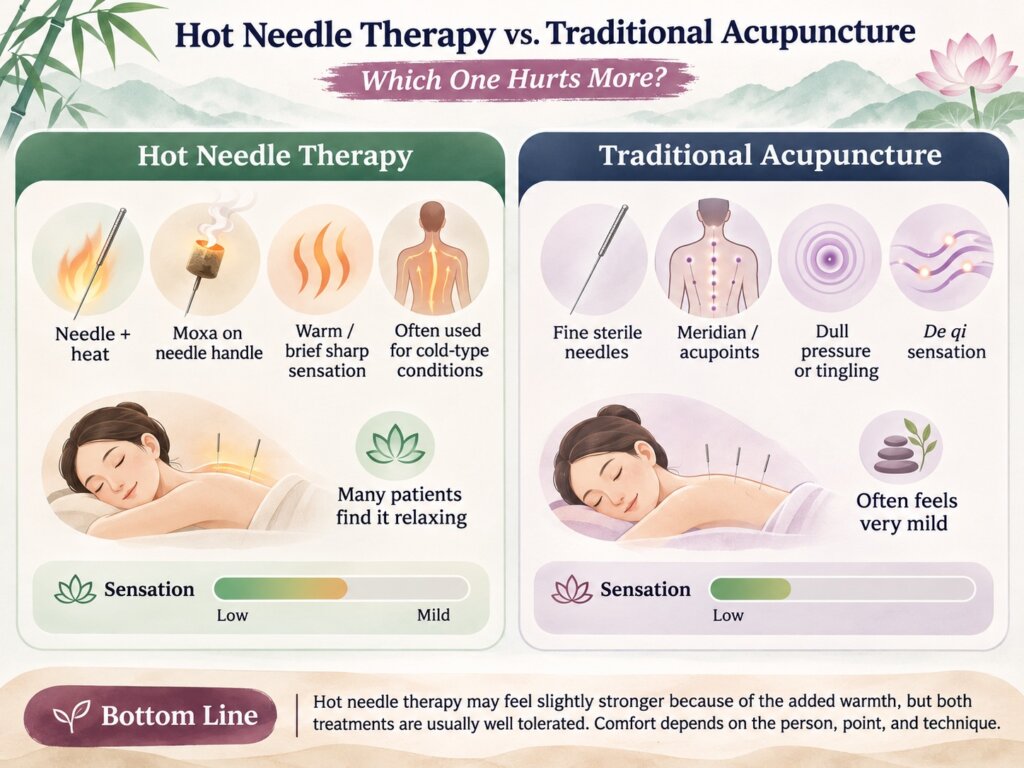
Hot needle therapy—sometimes called fire needling or warm needling—involves briefly heating the tip of a needle before insertion, or applying moxa (a dried herb) to the handle of an inserted needle to conduct warmth into the tissue below. The goal is to move stagnant energy, improve circulation, and address cold-type conditions in Traditional Chinese Medicine. It is not a new concept; practitioners have used heat-based needling techniques for centuries.
Traditional acupuncture, by contrast, uses fine, sterile needles inserted at specific points along the body’s meridian pathways without added heat. The sensation most people describe is a dull pressure, mild tingling, or a brief ache—what TCM practitioners call “de qi,” or the arrival of qi. Some points feel almost nothing at all.
So which one hurts more? Honestly, it depends. Hot needle therapy does introduce an additional layer of sensation—warmth, and sometimes a brief sharp feeling at insertion. But “pain” is not quite the right word for most patients. The heat is typically controlled, localized, and short-lived. Many people find the warmth deeply relaxing once the initial moment of insertion passes.
Understanding Hot Needle Therapy and How It Differs From Needle Decompression
Before going further, it is worth clearing up a common source of confusion. When people search for “needle therapy” online, they sometimes come across information about needle decompression—also called needle thoracostomy. These are not the same thing. Needle decompression is an emergency medical procedure used to treat a collapsed lung (tension pneumothorax). It is performed only by trained clinicians in acute care settings and carries significant risks including bleeding, infection, and lung injury. It has no connection to acupuncture or wellness care.
Hot needle therapy belongs entirely to the world of Traditional Chinese Medicine. It is performed at acupuncture points on the skin and muscle tissue, using fine needles that are briefly warmed. The mechanism, intent, and clinical setting are completely different from any emergency medical procedure.
This distinction matters—not just for clarity, but for safety. If you are researching needle-based therapies, make sure you are reading about the right one.
What Hot Needle Therapy Feels Like: A Step-by-Step Breakdown
Understanding the actual experience of a hot needle session can reduce a lot of the anxiety that comes with the unknown. Here is what typically happens during a session at a qualified clinic.
1. Initial Consultation and Point Selection for Hot Needle Therapy
Your practitioner will assess your condition, review your health history, and identify which acupuncture points are appropriate. At Acupuncture Colorado Springs, every session begins with a personalized evaluation led by David W. Armstrong, L.Ac., who tailors each treatment plan to your specific needs rather than following a generic protocol.
2. Needle Preparation and Heat Application in Hot Needle Therapy
The practitioner prepares sterile, single-use needles—no reused instruments, ever. Depending on the technique, moxa may be attached to the needle handle or the tip may be brieflywarmed before insertion. The heat is applied with precision and care.
3. Insertion and the Immediate Sensation During Hot Needle Therapy
Insertion is quick. Most patients feel a brief, sharp warmth at the point of entry, which typically fades within seconds. The sensation is more noticeable than standard acupuncture but is generally described as tolerable and even grounding.
4. Retention Period and Tissue Response in Hot Needle Therapy
Once the needles are placed, you rest quietly for 15 to 30 minutes. The warmth from the moxa or heated needle continues to work through the tissue, promoting circulation and releasing muscle tension. Many patients find this phase deeply calming.
5. Removal and Aftercare Following Hot Needle Therapy
Needle removal is gentle and quick. You may notice mild redness or warmth at the treated points, which typically resolves within a few hours. Your practitioner may recommend rest, hydration, or herbal support depending on your condition.
How Hot Needle Therapy Compares to Traditional Acupuncture: A Side-by-Side Look
People often want a direct comparison before committing to a session. The table below outlines the key differences between hot needle therapy and traditional acupuncture across several practical factors.
| Factor | Hot Needle Therapy | Traditional Acupuncture |
|---|---|---|
| Sensation at Insertion | Brief sharp warmth, more noticeable | Dull ache, tingling, or pressure (de qi) |
| Heat Involved | Yes—moxa or warmed needle tip | No heat applied |
| Best For | Cold-type conditions, chronic stiffness, poor circulation | Broad range of conditions including stress, pain, and digestive issues |
| Session Length | Similar—typically 45 to 60 minutes | Typically 45 to 60 minutes |
| Pain Level (General) | Slightly higher initial sensation | Mild to minimal discomfort |
| Safety | Safe with licensed practitioner and sterile needles | Safe with licensed practitioner and sterile needles |
| TCM Indication | Yang deficiency, cold bi syndrome, deep muscle tension | Qi stagnation, yin deficiency, varied conditions |
As you can see, the differences are meaningful but not dramatic. The right choice depends on your diagnosis, your constitution, and what your practitioner recommends after a thorough evaluation.
Who Is Hot Needle Therapy Best Suited For?
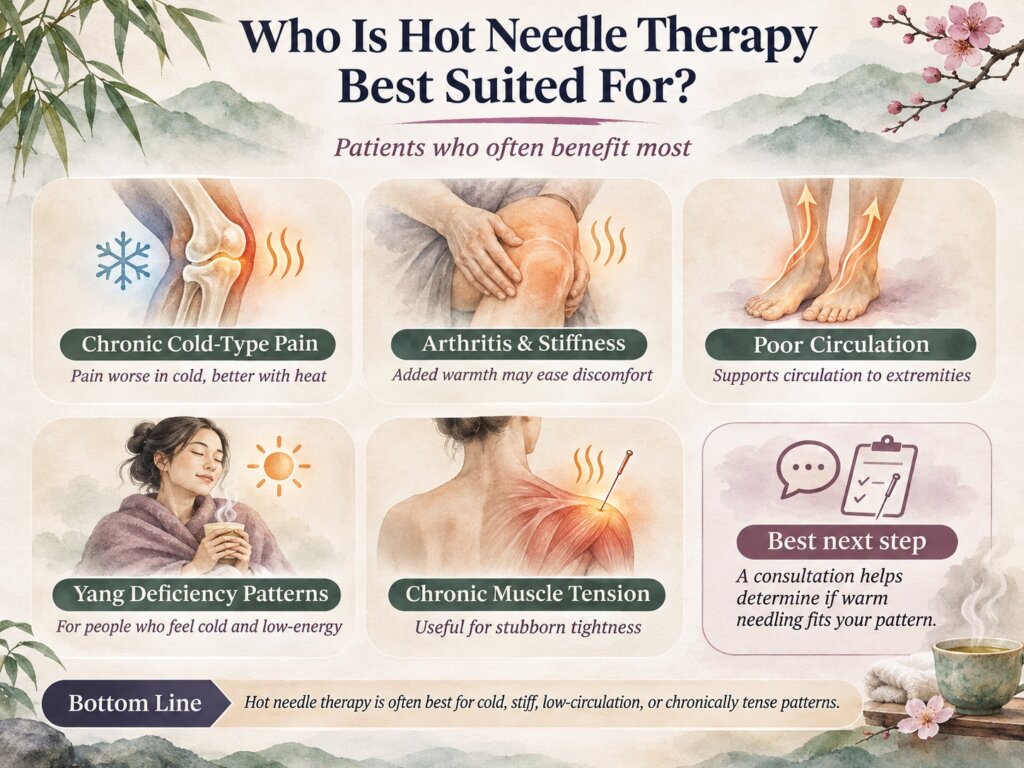
Not every patient is a candidate for hot needle therapy, and that is fine. In TCM, treatment selection is based on pattern diagnosis—not just symptoms. Here are the types of conditions and patient profiles where warm needling tends to be most appropriate.
- Chronic cold-type pain: If your joint or muscle pain feels worse in cold weather and improves with heat, warm needling may address the root pattern more directly than standard acupuncture alone.
- Arthritis and stiffness: Patients managing arthritis—especially those in Colorado Springs where altitude and dry winters can worsen joint discomfort—often respond well to the added warmth.
- Poor circulation: When blood flow to the extremities is sluggish, the heat from warm needling may support tissue perfusion and reduce numbness or heaviness.
- Yang deficiency patterns: In TCM terms, people who feel persistently cold, fatigued, or low in energy may benefit from the warming and activating nature of this technique.
- Chronic muscle tension: Deep, stubborn muscle knots that have not responded to standard needling sometimes respond to the combination of needle stimulation and localized heat.
If you are unsure whether hot needle therapy or traditional acupuncture is the right fit for your condition, a consultation is the best place to start. At Acupuncture Colorado Springs, we offer personalized evaluations where David W. Armstrong, L.Ac., reviews your full health picture before recommending any specific technique. You can reach us at our clinic at 2525 W Pikes Peak Ave, Suite B, Colorado Springs, CO 80904, or book a session through our website.
What About Other Needle-Adjacent Therapies? Clearing Up the Confusion
You might be wondering how hot needle therapy relates to other treatments you have seen mentioned online—things like red light therapy panels, blue light therapy, or even terms like growing therapy. These are worth addressing briefly, because the wellness space can be confusing.
Red light therapy panels use low-wavelength light to support collagen production and tissue repair. Research suggests some benefit for dermatologic applications, though clinical evidence varies and treatment parameters matter. Blue light therapy has documented antimicrobial effects, particularly relevant for acne, and home LED devices appear generally safe short-term—though eye protection is advised and long-term safety data is still developing. Neither of these involves needles of any kind.
Terms like growing therapy or biosilk silk therapy are not standardized medical terms. Biosilk silk therapy, for example, typically refers to a cosmetic hair-care product line rather than a clinical treatment. It is worth being cautious about any therapy that uses clinical-sounding language without a clear evidence base or professional oversight.
Hot needle therapy is distinct from all of these. It is a defined technique within Traditional Chinese Medicine with a documented history and a clear mechanism of action. When performed by a licensed acupuncturist, it is a structured clinical intervention—not a wellness trend or cosmetic product.
Safety, Licensing, and What to Look for in a Provider
Safety is non-negotiable when it comes to any needle-based therapy. Here is what you should confirm before booking a session anywhere.
- Licensing: Your practitioner should be licensed in your state and ideally board-certified through the NCCAOM (National Certification Commission for Acupuncture and Oriental Medicine).
- Sterile needles: Only FDA-approved, single-use, sterile needles should be used—every time, without exception.
- Clean Needle Technique: CNT protocols should be standard practice, not optional.
- Personalized assessment: A qualified practitioner will not apply hot needle therapy without first evaluating whether it is appropriate for your specific condition and constitution.
- Clear communication: You should feel comfortable asking questions and receiving honest, clear answers about what the treatment involves and what to expect.
At Acupuncture Colorado Springs, we follow all Colorado state licensing requirements and CNT protocols. David W. Armstrong, L.Ac., is NCCAOM board-certified in both acupuncture and Chinese herbal medicine. Every session uses single-use, sterile needles, and every treatment plan is built around your individual diagnosis. If you are in the Colorado Springs area—including Manitou Springs, Woodland Park, or El Paso County—we welcome you to come in and ask every question you have before committing to any treatment. You can also explore our Chinese herbal medicine options, which pair well with both hot needle therapy and traditional acupuncture for deeper, longer-lasting support.
Final Thoughts on Hot Needle Therapy and Traditional Acupuncture
Hot needle therapy does involve a slightly more noticeable sensation than standard acupuncture, but for most patients, it is not painful in the way the name might suggest. The warmth is brief, localized, and often described as relieving rather than uncomfortable. Whether it is the right choice for you depends on your diagnosis, your body’s response to cold and heat, and what a qualified practitioner recommends after a full evaluation. If you are curious, the best next step is a conversation—not a guess.
Acupuncture Colorado Springs offers board-certified holistic acupuncture care tailored to your comfort and needs. David W. Armstrong, L.Ac. guides every personalized treatment. Get started today by calling our Colorado Springs clinic.
FAQs
What Is Hot Needle Therapy?
Hot needle therapy is a Traditional Chinese Medicine technique where a warmed acupuncture needle is applied after insertion to combine acupuncture stimulation with gentle heat, often used to support circulation and tissue recovery.
What Is Hot Needle Therapy Used For?
It’s commonly used for chronic pain, stiffness, arthritis-type patterns, cold-damp conditions, and lingering injuries—especially when symptoms improve with warmth and worsen with cold.
Does Hot Needle Therapy Hurt?
Most patients feel a brief pinch on insertion and then a warming sensation; it isn’t typically more painful than traditional acupuncture, and we adjust technique to keep treatment comfortable and appropriate for your condition.
Is Hot Needle Therapy Safe?
Yes, when performed by a licensed, board-certified acupuncturist using proper protocols; at Acupuncture Colorado Springs, we use single-use sterile needles and careful heat control to ensure safe, hygienic treatment.
How Much Does Hot Needle Therapy Cost?
Cost varies based on whether it’s included within an acupuncture session or used as an add-on; we’ll confirm pricing and a personalized care plan before treatment.