Your wrists do a lot of work. Whether you spend hours typing at a desk, swinging a hammer on a job site, or gripping a steering wheel through long commutes, repetitive motion adds up. Over time, that daily demand can create tension, inflammation, and pain that interferes with basic tasks. If you have been looking for a natural, non-invasive approach to wrist discomfort, hand acupuncture may be worth understanding.
This article covers what hand acupuncture is, how it relates to wrist strain and repetitive use injuries, what the research suggests, and what a personalized treatment plan might look like. You will also learn how Acupuncture Colorado Springs supports patients dealing with these exact concerns through evidence-informed, root-cause-focused care.
Key Takeaways
- Hand acupuncture targets specific points on the hand and wrist to address pain and inflammation linked to repetitive strain.
- Traditional Chinese Medicine views wrist pain as a disruption in the flow of qi through specific meridian pathways.
- Research from institutions like the NCCIH and Harvard Health supports acupuncture’s role in managing musculoskeletal pain.
- Korean hand acupuncture is a microsystem approach that maps the entire body onto the hand for targeted treatment.
- Personalized care at Acupuncture Colorado Springs goes beyond symptom relief to address the underlying patterns driving your discomfort.
- Treatment may include acupuncture and cupping depending on your individual presentation.
What Hand Acupuncture Does for Wrist Strain and Repetitive Use Injuries

Hand acupuncture is a focused application of Traditional Chinese Medicine (TCM) that uses fine, sterile needles placed at specific points on the hand, wrist, and surrounding tissue to address pain and dysfunction. According to Johns Hopkins Medicine, acupuncturists work with more than 2,000 identified acupuncture points throughout the body, many of which are clustered along the hands, wrists, and forearms. These points connect through pathways called meridians, which TCM associates with the flow of energy, or qi, through the body.
When repetitive motion strains the tendons, muscles, and joints of the wrist, TCM interprets this as a stagnation of qi and blood in those meridians. Stimulating acupuncture points near the wrist may help restore circulation, reduce local inflammation, and signal the nervous system to ease pain responses.
One well-documented microsystem within this field is Korean hand acupuncture, which maps the entire human body onto the surface of the hand. Practitioners trained in this approach can treat wrist, elbow, and shoulder complaints by working almost entirely within the hand itself, which some patients find less intimidating than full-body needling.
Why Repetitive Use Injuries Are Difficult to Treat With Rest Alone
Repetitive strain injuries, sometimes called RSIs, develop gradually. They are not the result of one dramatic incident but rather the slow accumulation of microtrauma to tendons, muscles, and connective tissue. Common examples include carpal tunnel syndrome, de Quervain’s tenosynovitis, and general wrist tendinopathy. These conditions affect people in physically demanding jobs, office workers, musicians, and athletes alike.
The challenge with RSIs is that rest alone often does not resolve the underlying tissue changes. Inflammation may quiet down temporarily, but without addressing circulation, nerve sensitivity, and muscular tension in the surrounding area, the pain tends to return once activity resumes. This is where acupuncture offers something different.
The Mayo Clinic notes that acupuncture is most commonly used to treat pain and is considered a key component of TCM care. For repetitive use injuries specifically, the goal is not just to dull the pain signal but to support the body’s own repair process at a tissue level.
How Hand Acupuncture Works: The Mechanisms Behind the Needles
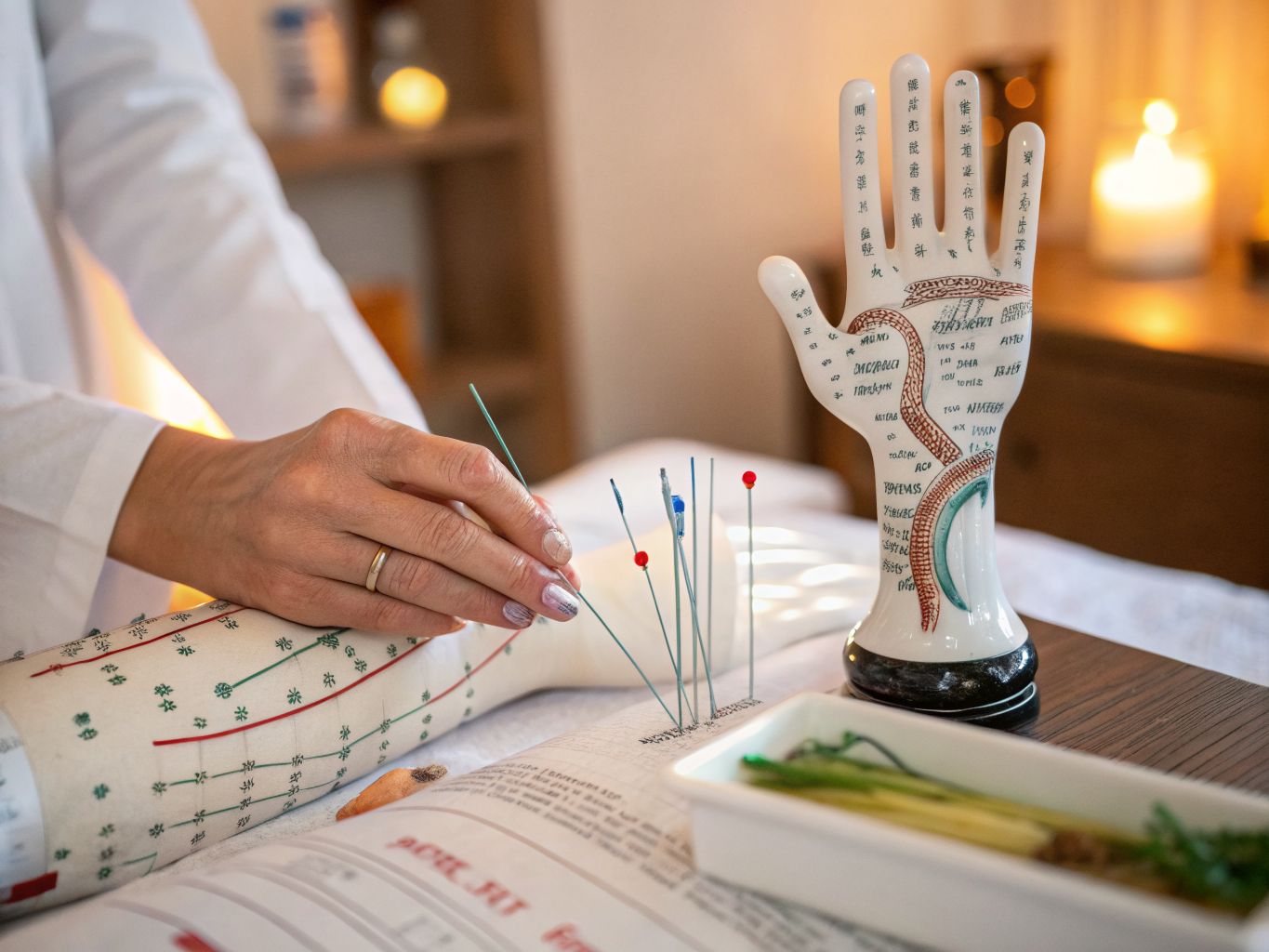
You might be wondering how placing a needle in the hand could affect pain in the wrist or forearm. The answer involves both traditional theory and some modern physiological explanation. From a TCM perspective, the Large Intestine, Triple Warmer, and Pericardium meridians all pass through the wrist and hand, and disruptions along these pathways are associated with stiffness, numbness, and aching in the area.
From a biomedical standpoint, needle insertion stimulates local tissue responses that may include increased blood flow, the release of endorphins, and changes in how pain signals are processed in the spinal cord and brain. Harvard Health has reviewed multiple studies showing that acupuncture is used primarily for pain management, with evidence supporting its effect on musculoskeletal complaints even when the precise mechanisms remain under investigation.
The NCCIH also notes that acupuncture has a strong safety profile when performed by a licensed practitioner using sterile, single-use needles. At our clinic, every session meets Colorado state licensing requirements and uses only professionally sourced, single-use needles.
Common Wrist Conditions That Hand Acupuncture May Support
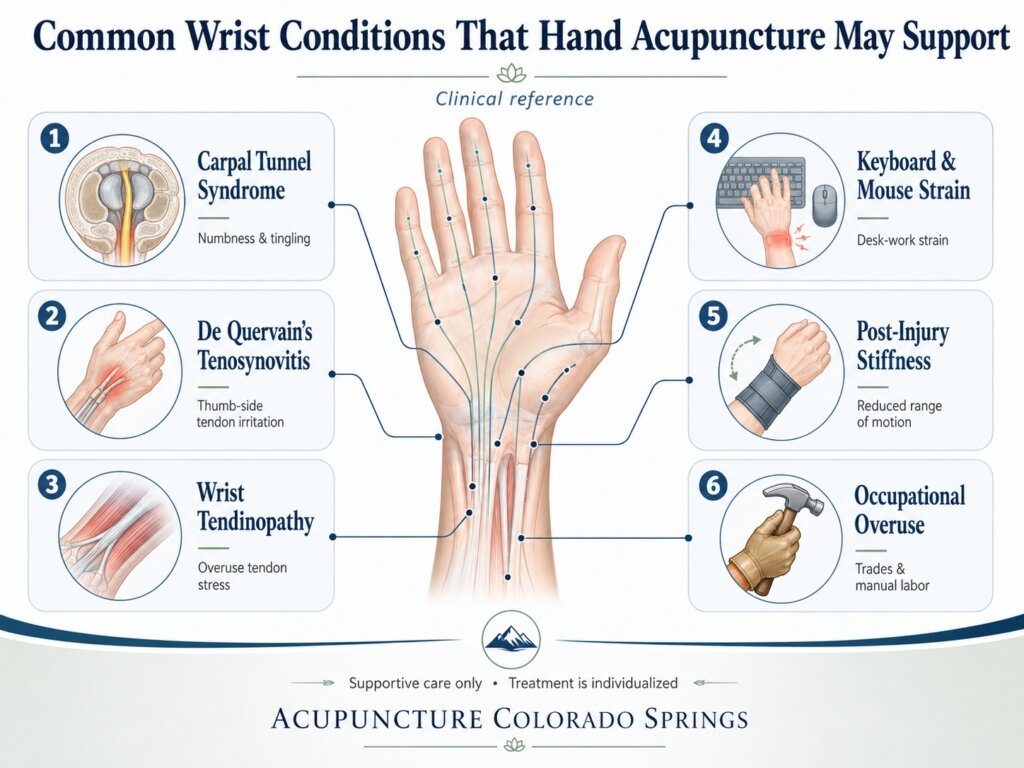
Not every wrist complaint looks the same, and the right acupuncture approach depends on your specific presentation. Here are conditions where hand acupuncture is often incorporated into a broader treatment plan:
1. Carpal Tunnel Syndrome
Compression of the median nerve through the carpal tunnel causes numbness, tingling, and weakness in the hand. Acupuncture points along the Pericardium meridian, which runs directly through the carpal tunnel area, are commonly used to reduce nerve irritation and local swelling.
2. De Quervain’s Tenosynovitis
This condition involves inflammation of the tendons on the thumb side of the wrist. It is common in new parents, construction workers, and anyone who performs repetitive gripping or pinching motions. Needling along the Large Intestine meridian pathway may support tendon recovery and reduce localized inflammation.
3. Wrist Tendinopathy
General tendon degeneration from overuse responds well to approaches that improve local circulation. Acupuncture may help by stimulating blood flow to areas with poor vascularization, which is a known challenge in tendon healing.
4. Repetitive Strain From Keyboard and Mouse Use
Office workers in Colorado Springs often present with a combination of wrist tightness, forearm tension, and neck stiffness from prolonged desk work. Hand acupuncture, combined with points along the forearm and shoulder, can address the full chain of tension rather than treating the wrist in isolation.
5. Post-Injury Stiffness and Reduced Range of Motion
After a sprain or fracture has healed, residual stiffness and guarding patterns can limit wrist mobility for months. Acupuncture may support the release of scar tissue adhesions and restore normal movement patterns when used alongside rehabilitation.
6. Occupational Overuse in Trades and Manual Labor
Carpenters, plumbers, electricians, and other tradespeople in the Colorado Springs area put significant repetitive demand on their hands and wrists. For someone in construction who wants to stay active without relying on daily pain medication, a consistent acupuncture care plan can be a practical and sustainable option.
If any of these patterns sound familiar, scheduling a consultation at Acupuncture Colorado Springs is a straightforward next step. David W. Armstrong, L.Ac., will review your health history, assess the specific meridian and tissue patterns involved, and build a treatment plan around your actual needs rather than a generic protocol.
What a Hand Acupuncture Session for Wrist Strain Actually Looks Like
Walking into a session for wrist-related complaints, you can expect the visit to begin with a conversation. David will ask about your daily activities, how long the discomfort has been present, what makes it better or worse, and whether there are related symptoms like numbness, sleep disruption, or neck tension. This intake process is not a formality. It shapes the entire treatment.
Needles used in hand acupuncture are extremely fine, much thinner than a hypodermic needle, and most patients describe the sensation as a mild pressure or warmth rather than pain. Points may be selected on the hand itself, along the forearm, or at distal locations on the body that correspond to the affected meridians. Sessions typically last between 45 and 60 minutes, and the number of visits recommended will depend on how long the condition has been present and how your body responds.
Cleveland Clinic notes that acupuncture sessions vary in technique and that skilled practitioners adapt their approach based on individual patient needs. This is exactly how we operate at our clinic. No two wrist complaints are treated identically because no two patients are identical.
Comparing Treatment Approaches for Wrist Strain
| Approach | Primary Mechanism | Addresses Root Cause | Invasive | Common Use Case |
|---|---|---|---|---|
| Hand Acupuncture | Meridian stimulation, nerve and tissue response | Yes, through TCM pattern assessment | Minimally | Chronic RSI, tendinopathy, nerve pain |
| NSAIDs / Pain Medication | Blocks inflammatory signals | No | No | Short-term pain management |
| Physical Therapy | Strengthening and mobility work | Partially | No | Post-injury rehabilitation |
| Corticosteroid Injection | Reduces local inflammation | No | Yes | Acute flare-ups |
| Cupping Therapy | Improves circulation, releases fascial tension | Partially | No | Muscle tension, forearm tightness |
As the table shows, hand acupuncture stands apart because it aims to address the patterns behind your symptoms rather than simply managing them. When combined with cupping therapy, which we also offer at Acupuncture Colorado Springs, the approach becomes even more comprehensive.
Supporting Your Recovery Beyond the Needle
Hand acupuncture works best as part of a broader care strategy. At our clinic, treatment for wrist strain may include cupping along the forearm to release deep fascial tension and Chinese herbal medicine guidance to support tissue repair and reduce systemic inflammation. These are not add-ons. They are tools that address different layers of the same problem.
We also talk with patients about practical adjustments, things like workstation setup, grip habits, and movement breaks during the day. Colorado Springs has a physically active population, and whether you are managing a demanding job or trying to stay active in the outdoors, small changes in how you use your hands can make a meaningful difference in your recovery timeline.
If you have been managing wrist pain with rest and over-the-counter medication without lasting results, it may be time to look at what is actually driving the discomfort. Our services page outlines the full range of treatments available, and booking a first appointment is easy through our online scheduler at 2525 W Pikes Peak Ave, Suite B, Colorado Springs, CO 80904.
Conclusion
Hand acupuncture offers a focused, evidence-informed approach to wrist strain and repetitive use injuries that goes beyond surface-level symptom relief. At Acupuncture Colorado Springs, David W. Armstrong, L.Ac., designs every care plan around your specific patterns, lifestyle, and goals. If wrist pain is slowing you down, a personalized consultation may be the most direct path toward lasting relief.
Acupuncture Colorado Springs offers board-certified acupuncture care targeting wrist strain and repetitive-use injuries at the root. David W. Armstrong, L.Ac. builds personalized treatment plans designed for lasting relief. Get started today by booking your consultation.
FAQs
What Is Hand Acupuncture Used For?
Hand acupuncture is commonly used to help reduce pain and inflammation and improve function in issues like wrist strain, repetitive-use injuries (such as typing or gripping), tendon irritation, and related forearm or hand discomfort. In Traditional Chinese Medicine, hand points can also help regulate stress and support overall balance, and we often combine them with body acupuncture or cupping for more complete, root-cause-focused care.
Does Hand Acupuncture Really Work?
For many people, yes—hand acupuncture can be effective for pain relief and improved mobility, especially when symptoms are tied to overuse, muscle tension, or tendon irritation. Results vary by condition and severity, but a personalized plan and accurate point selection are key; in our clinic, we tailor treatment based on your history, daily activities, and exam findings rather than using a one-size-fits-all protocol.
What Are the Pressure Points on the Hand for Pain Relief?
Common hand points used for pain relief include LI4 (between the thumb and index finger) and points along the web spaces and metacarpals that influence the hand, wrist, and forearm. The best points depend on where your pain is and what movements aggravate it, so it’s safest and most effective to have them selected and applied by a licensed acupuncturist—especially for wrist strain and repetitive-use patterns.
Is Hand Acupuncture Safe and Are There Side Effects?
Hand acupuncture is generally very safe when performed by a licensed professional using sterile, single-use needles. Possible side effects are usually mild and short-lived, such as brief soreness, small bruising, light bleeding, or temporary fatigue/relaxation. We follow Colorado safety and hygiene standards and adjust techniques to your comfort level and medical history.
How Long Do the Effects of Hand Acupuncture Last?
Some people feel relief the same day that can last hours to days, while longer-lasting improvement typically builds over a series of treatments—especially for repetitive-use wrist strain. How long results last depends on factors like how long the problem has been present, your workload and ergonomics, tissue irritation level, and whether we also address contributing issues such as neck/shoulder tension, stress, and recovery habits.