If you have ever looked into Traditional Chinese Medicine, you have probably come across terms like chi, energy points, and meridians. They often get used interchangeably, but they actually describe different things. Understanding the distinction matters, especially if you are trying to make sense of what happens during an acupuncture session or why certain pressure points seem to carry more weight than others in both healing and martial arts traditions.
This article breaks down what chi points in the body actually are, how they compare to acupuncture meridians, and why that difference is more than just academic. You will also learn how these concepts connect to real treatment decisions, what the research says, and how a personalized TCM approach can support your health right here in Colorado Springs.
Key Takeaways
- Chi points in the body are specific locations where vital energy is thought to concentrate or be accessed.
- Acupuncture meridians are the pathways or channels through which chi flows throughout the body.
- The two concepts work together but serve different roles in Traditional Chinese Medicine theory and practice.
- Pressure points of the human body for self-defense, as used in martial arts, overlap with but are not identical to acupuncture points.
- A licensed acupuncturist uses both point selection and meridian theory to create a treatment plan tailored to your specific pattern of imbalance.
What Are Chi Points in the Body, and How Do They Relate to Chi in the Body?

Chi points in the body, often called acupoints or acupuncture points, are precise locations on the skin’s surface where chi — the body’s vital energy — is believed to be especially accessible. In Traditional Chinese Medicine, chi in the body is not just a vague concept. It refers to a functional force that animates every physiological process, from digestion to immune response to emotional regulation. According to the National Cancer Institute’s overview of acupuncture, these points are specific sites where needles are inserted to influence the flow of energy along defined pathways.
Think of chi points as access doors. They are where a practitioner can reach in, so to speak, and influence what is happening deeper in the system. Each point has a name, a number, a location, and a set of known clinical functions that have been documented over centuries of practice.
You might be wondering how many of these points exist. Classical texts describe 365 primary acupoints, though modern TCM practice recognizes over 400, including extra points that fall outside the main channel system. Each one is associated with specific organs, symptoms, and therapeutic effects.
Acupuncture Meridians: The Chi Body’s Network of Pathways
If chi points are the doors, then acupuncture meridians are the hallways connecting them. Meridians are channels or pathways through which chi flows in a continuous, organized circuit throughout the chi body. The National Center for Complementary and Integrative Health (NCCIH) describes this system as a network of pathways that link acupuncture points to internal organs and body systems. There are 12 primary meridians, each associated with a major organ system such as the Lung, Liver, Kidney, or Heart, and 8 extraordinary vessels that serve deeper regulatory functions.
Meridians do not correspond to any single anatomical structure visible under a microscope. They represent functional relationships — patterns of how the body regulates itself — rather than physical tubes or wires. This is one reason TCM can feel abstract to people trained in Western anatomy.
The distinction matters clinically. A practitioner might needle a chi point on your foot to influence your digestive system, not because the foot has anything to do with digestion anatomically, but because that point sits on a meridian that connects to the stomach or spleen organ network. That is meridian theory in action.
Chi Points in the Body vs. Acupuncture Meridians: A Direct Comparison
People often conflate these two concepts, and it is easy to see why. They are deeply interconnected. But treating them as the same thing leads to confusion about how TCM actually works. The table below outlines the core differences.
| Feature | Chi Points in the Body | Acupuncture Meridians |
|---|---|---|
| Definition | Specific locations where chi is accessed | Pathways through which chi flows |
| Number | Over 400 recognized points | 12 primary + 8 extraordinary vessels |
| Function in Treatment | Sites of needle insertion or manual pressure | Framework for understanding energy flow |
| Relationship to Anatomy | Fixed surface locations on the body | Functional channels, not anatomical structures |
| Role in Diagnosis | Selected based on symptoms and patterns | Identifies which organ system is affected |
| Connection to Martial Arts | Overlap with pressure points of the human body for self-defense | Less directly applied in martial arts body training |
As you can see, the two concepts are related but not interchangeable. Meridians give you the map. Chi points give you the destinations on that map where you can actually do something.
How Chi Points in the Body Connect to Pressure Points and Martial Arts
Here is where things get interesting for people who come from a martial arts background or who have heard about the pressure points of the human body for self-defense. In martial arts traditions, particularly in Chinese and Japanese systems, certain body points are known to be sensitive or vulnerable. Strike them correctly and you can disrupt an opponent’s balance, cause pain, or temporarily impair function. These are often called dim mak points or vital points in a martial arts body context.
Many of these martial arts body points overlap directly with classical acupoints. The point known as ST-36 on the lower leg, for example, is one of the most commonly used acupuncture points for building energy and supporting digestion. It also appears in some martial arts traditions as a sensitive strike target. The point GB-21 on the shoulder is another example — used in acupuncture for neck tension and headaches, and known in certain martial arts systems as a point that can cause a person to buckle when pressed firmly.
The overlap makes sense when you consider that both traditions developed from the same foundational understanding of chi in the body. The difference is intent and application. In TCM, these points are stimulated gently and precisely to restore balance. In a martial arts context, they are targeted to disrupt it. Same location, opposite goal.
It is worth noting that the idea of using pressure points of the human body for self-defense has been romanticized in popular culture far beyond what is clinically or practically documented. The therapeutic use of these points in acupuncture is much better supported by research and clinical evidence than their use as combat techniques.
How a Licensed Acupuncturist Uses Both Concepts in Practice
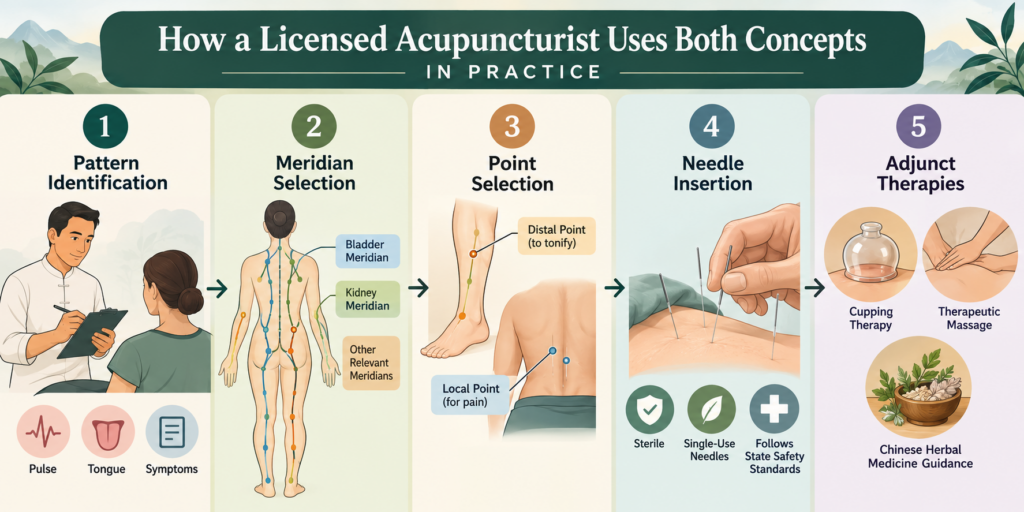
At Acupuncture Colorado Springs, David W. Armstrong, L.Ac., does not just select random points. Every treatment begins with a thorough assessment of your health history, current symptoms, and the underlying pattern of imbalance driving those symptoms. That assessment determines which meridians are involved and which specific chi points in the body are most appropriate for your situation.
Here is a simplified look at how that process works in a clinical setting:
1. Pattern Identification
David evaluates your pulse, tongue, and symptom history to identify which organ systems and meridians are out of balance. This is the foundation of TCM diagnosis.
2. Meridian Selection
Based on the pattern, specific meridians are identified as the primary pathways to address. For example, chronic lower back pain in a physically active person might point to Kidney meridian deficiency combined with Bladder meridian obstruction.
3. Point Selection
Within those meridians, specific chi points in the body are chosen based on their known therapeutic functions. A point on the lower leg might be selected to tonify the Kidney, while a local point on the lumbar spine addresses the site of pain directly.
4. Needle Insertion
Sterile, single-use needles are placed at the selected points. The goal is to stimulate chi flow, reduce stagnation, and support the body’s own regulatory processes. Our clinic follows all Colorado state safety and hygiene standards.
5. Adjunct Therapies
Depending on your condition, David may incorporate cupping therapy, therapeutic massage, or Chinese herbal medicine guidance alongside acupuncture to address your pattern more fully. If you are dealing with chronic tension, stress-related fatigue, or pain that has not responded to other approaches, these combined therapies can offer a more complete response than needles alone.
If you are curious about what a first visit looks like from start to finish, our team at Acupuncture Colorado Springs is happy to walk you through the process. You can also explore our services page to get a clearer picture of what we offer and how each therapy fits into a personalized care plan.
Why This Distinction Matters for Your Health
Understanding the difference between chi points in the body and acupuncture meridians is not just trivia. It shapes how you interpret your treatment, communicate with your practitioner, and set realistic expectations for care. When someone says acupuncture did not work for them, it is often because the point selection or meridian approach was not matched to their specific pattern — not because acupuncture itself is ineffective.
Research published through the National Institutes of Health has shown that acupuncture can support pain reduction, stress response regulation, and functional improvement for a range of conditions. The NCCIH notes that acupuncture is one of the most studied complementary health approaches, with a growing body of evidence supporting its use for chronic pain, headaches, and nausea, among other concerns.
For people in Colorado Springs managing the physical demands of an active lifestyle, the stress of demanding work, or the cumulative toll of altitude and dry air on the body, getting the meridian and point selection right makes a real difference. A generic protocol will not do that. A personalized assessment will.
That is exactly why our clinic takes the time at every visit to reassess your pattern and adjust the treatment accordingly. Your chi body is not static, and neither is your care plan.
What Makes Acupuncture Colorado Springs Different in This Approach
Plenty of clinics offer acupuncture. What sets Acupuncture Colorado Springs apart is the depth of assessment behind every treatment. David W. Armstrong, L.Ac., brings decades of clinical experience to each session, drawing on both classical TCM theory and modern, evidence-informed practice to select the most appropriate chi points in the body for your specific pattern.
We serve patients across the greater Colorado Springs area, including Manitou Springs, Old Colorado City, and Woodland Park. Whether you are dealing with chronic pain, hormonal imbalance, digestive issues, or stress and sleep disruption, we approach your care the same way — by looking at the whole picture, not just the surface complaint. Our calm clinic environment at 2525 W Pikes Peak Ave, Suite B, is designed to support that process from the moment you walk in.
If you are ready to understand your body’s patterns more clearly and explore what targeted acupuncture care can do for you, we invite you to schedule a consultation with our team. There is no generic protocol waiting for you here — just a thoughtful conversation and a plan built around your actual needs.
Closing Thoughts on Chi Points and Meridians
Chi points in the body and acupuncture meridians work together as a system, not as separate ideas. The meridians give practitioners a framework for understanding energy flow; the chi points give them precise locations to create change. When both are applied with skill and intention, the result is care that addresses root causes rather than surface symptoms. If you are in Colorado Springs and want to experience what that kind of personalized TCM care feels like, reach out to Acupuncture Colorado Springs — we are here to help you find lasting balance, less pain, and better function.
Acupuncture Colorado Springs brings expert knowledge of traditional acupuncture meridian therapy to every session. Board-certified practitioner David W. Armstrong designs personalized treatments targeting root causes. Get started on your healing journey today!
FAQs
What Are Chi Points in the Body?
“Chi points” generally refers to specific spots used in Traditional Chinese Medicine (TCM) to influence the flow of qi (often spelled “chi”), the body’s vital energy. In clinical practice, these usually align with acupuncture points, which are mapped locations used to support pain relief, stress reduction, and overall balance based on an individualized assessment.
Where Are the Chi Points Located in the Body?
Chi points are found throughout the body—on the head and face, ears, arms and hands, chest and abdomen, back, legs and feet. Many are located along acupuncture meridians (pathways described in TCM), while others are used for their local effects (for example, near areas of pain or tension) depending on your symptoms and pattern.
How Do You Activate Chi Points?
Chi points can be stimulated through acupuncture, acupressure, gentle massage, cupping in certain areas, breathwork, and movement practices like tai chi or qigong. In a clinic setting, a licensed acupuncturist selects points based on your root pattern—not just the symptom—then adjusts the approach over time as your body responds.
What Happens When Chi Points Are Blocked?
In TCM terms, “blocked” qi flow can show up as pain, tightness, irritability, poor sleep, digestive discomfort, headaches, or fatigue—often with symptoms that come and go or feel worse with stress. Treatment aims to improve circulation of qi and blood, calm the nervous system, and support the body’s natural regulation so symptoms ease and resilience improves.
Are Chi Points the Same as Acupuncture Points?
Most of the time, yes—people use “chi points” as a casual term for acupuncture points. The more precise term is “acupuncture points,” which are specific, clinically used locations on the body (many along meridians) that a trained practitioner selects and combines to address both immediate symptoms and underlying imbalances.