Acupuncture has helped millions of people manage pain, stress, and chronic health conditions. But if you’re considering treatment for the first time, you probably have questions about safety—especially when it comes to acupuncture side effects and nerve damage. Those concerns are valid, and you deserve clear, honest answers before you ever lie down on a treatment table.
This article breaks down what the research actually says about acupuncture side effects, how nerve damage can occur and how rare it truly is, what normal sensations feel like versus warning signs, and how choosing a qualified practitioner makes all the difference. You’ll also learn how Acupuncture Colorado Springs approaches every treatment with the kind of care and clinical precision that keeps patients safe and comfortable.
Key Takeaways
- Most acupuncture side effects are mild and temporary, including minor soreness, light bruising, or brief fatigue.
- Nerve damage from acupuncture is rare but real, occurring in an estimated 5.76 cases per 10,000 treatments.
- Sharp, burning, or electric-shock sensations during needling are warning signs that differ from normal treatment sensations.
- Qualified, licensed practitioners significantly reduce the risk of serious adverse events.
- Acupuncture works by stimulating the nervous system, modulating pain pathways, and triggering endorphin release.
- Patients with high treatment counts or untrained providers face a measurably higher risk of complications.
Understanding acupuncture side effects and nerve damage starts with knowing how the therapy actually works—and what your body is supposed to feel during a session.
What Acupuncture Side Effects and Nerve Damage Actually Look Like
When people ask “does acupuncture hurt,” the honest answer is: not much, and not in the way you’d expect. Major medical centers, including the Cleveland Clinic, describe acupuncture as the insertion of very fine, sterile needles into specific anatomical points to stimulate the nervous system, modulate pain pathways, and encourage the release of endorphins. Most patients feel only a small prick at insertion, followed by sensations like a dull ache, mild tingling, or a sense of heaviness around the needle site. These are normal and expected responses—substantially less uncomfortable than a standard blood draw.
Acupuncture side effects, when they do occur, tend to be minor. Systematic reviews report that the most common reactions include pain at needle sites (roughly 11.8% of reports), minor bleeding or bruising (around 9.8%), brief dizziness, hematoma formation, and short-lived fatigue or mild digestive upset. These effects typically resolve on their own within a day or two.
Nerve damage is a different category entirely. It is classified as a rare but real adverse event. Research estimates approximately 5.76 nerve injury cases per 10,000 treatments, often involving spinal cord or upper-limb nerves. One Taiwan cohort study found that risk increases with very high treatment counts—specifically over 36 sessions—which underscores why ongoing clinical assessment matters throughout any course of care.
Can Acupuncture Cause Nerve Damage? Understanding the Real Risk

The question “can acupuncture cause nerve damage” comes up often, and it deserves a direct answer. Yes, it can—but the circumstances matter enormously. Nerve injuries in acupuncture tend to happen when needles are placed incorrectly, inserted too deeply, or angled toward anatomically sensitive structures without proper training. The difference between a skilled practitioner and an untrained one is not subtle when it comes to outcomes like this.
Clinically, there is a clear distinction between normal treatment sensations and signs of nerve irritation. If a needle accidentally contacts a nerve, you may feel a sharp, burning, or electric-shock sensation rather than the usual dull ache associated with proper needle placement. That kind of sensation is a warning sign. Most peripheral nerve irritation cases do improve over weeks because nerves have the capacity to heal. Serious central nervous system injuries, though documented in the literature, are almost exclusively associated with untrained or unlicensed providers.
| Sensation Type | What It Likely Means | What to Do |
|---|---|---|
| Dull ache, heaviness, mild tingling | Normal needle response (De Qi sensation) | Relax and breathe; this is expected |
| Sharp, burning, or electric-shock feeling | Possible nerve contact or irritation | Tell your practitioner immediately |
| Persistent numbness after session | Possible peripheral nerve irritation | Contact your provider; monitor closely |
| Minor bruising or soreness at needle site | Common, temporary side effect | Apply light pressure; resolves in 1–2 days |
| Dizziness or lightheadedness during session | Vasovagal response, more common in new patients | Inform your practitioner; rest afterward |
With that risk context established, it’s worth looking at how proper technique and anatomical knowledge directly protect you during treatment.
How Does Acupuncture Work Near Sensitive Nerves and Structures

Understanding how does acupuncture work near sensitive anatomical areas helps explain why practitioner skill is so central to safety. Points along the neck, upper back, and shoulders—areas commonly used for acupressure points for neck pain and cervical tension—sit in close proximity to major nerves and blood vessels. These regions require precise needle depth, angle, and placement to achieve therapeutic effect without causing harm. A trained acupuncturist maps these structures before every insertion.
At Acupuncture Colorado Springs, David W. Armstrong, L.Ac. brings years of clinical experience to every session. Before any needles are placed, David conducts a thorough intake conversation covering your health history, current medications, prior injuries, and treatment goals. That assessment shapes every decision made during your session—including which points to use, how deeply to needle, and which areas to approach with extra care.
We use only sterile, single-use needles and operate in full compliance with Colorado state licensing and hygiene regulations. There are no shortcuts taken with safety, and no generic protocols applied without thought. If you’re coming in for neck pain, shoulder tension, or upper-back stiffness—conditions where acupressure points for neck pain are commonly indicated—you can expect a precise, individualized approach that accounts for your anatomy, not just a standard point prescription.
If you’d like to learn more about how we structure a first visit, our What Is Acupuncture page walks through the process from intake to follow-up care.
Common Acupuncture Side Effects: What Is Normal and What Is Not
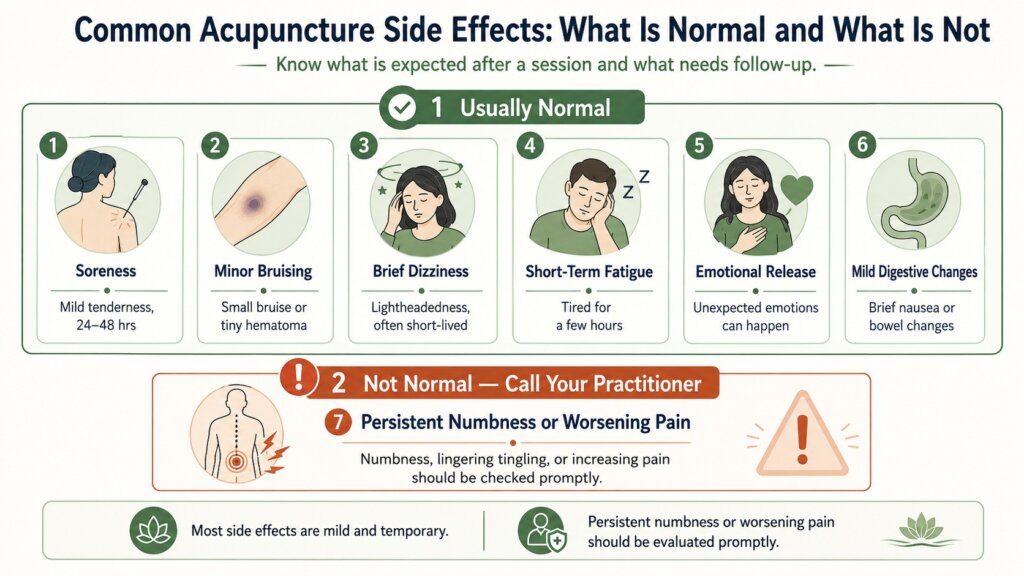
Knowing what to expect after a session helps you distinguish normal recovery from something that needs attention. Most people leave a treatment feeling relaxed, sometimes a little drowsy, and occasionally mildly sore at needle sites. That is your body responding to stimulation—it is not a sign that anything went wrong.
Here is a breakdown of what falls within the normal range and what warrants a follow-up call to your practitioner.
1. Soreness or Tenderness at Needle Sites
Light soreness around insertion points is the most frequently reported acupuncture side effect. It usually fades within 24 to 48 hours and does not require treatment.
2. Minor Bruising or Small Hematomas
Tiny bruises can form if a needle passes near a superficial capillary. This is more common in patients on blood thinners or those with fragile skin. It resolves on its own.
3. Brief Dizziness or Lightheadedness
Some patients, especially first-timers or those who come in on an empty stomach, experience a mild vasovagal response. Eating a light meal beforehand and resting after your session helps prevent this.
4. Short-Term Fatigue
Feeling tired after acupuncture is common and is often interpreted as the body shifting into a parasympathetic, rest-and-repair state. It typically passes within a few hours.
5. Temporary Emotional Release
Some patients feel unexpectedly emotional during or after a session. This is not unusual in Traditional Chinese Medicine, where emotional states are understood to be stored in the body’s tissues and organ systems.
6. Mild Digestive Changes
Brief changes in digestion—either increased activity or mild nausea—can occur, particularly with points used to regulate the digestive system. These effects are short-lived.
7. Persistent Numbness or Worsening Pain After a Session
This is not normal. If you experience numbness, tingling that does not resolve, or pain that worsens significantly in the days following treatment, contact your practitioner. These symptoms may indicate nerve irritation and should be evaluated promptly.
Most of what patients experience falls clearly into the first six categories. The seventh is uncommon, but knowing about it means you can respond appropriately if it ever comes up.
Who Faces Higher Risk and How to Reduce It
Certain patients carry a higher baseline risk for adverse events. Research identifies several factors that increase the likelihood of complications from acupuncture side effects and nerve damage, and being aware of them helps you and your provider make informed decisions together.
- Very high treatment frequency: Studies suggest risk of nerve injury increases with over 36 cumulative sessions, making periodic reassessment important in long-term care plans.
- Blood-thinning medications: Anticoagulants increase bruising and bleeding risk at needle sites. Always disclose all medications during your intake.
- Pacemakers or implanted devices: Certain adjunct techniques like electroacupuncture require modification or avoidance in these patients.
- Pregnancy: Some acupuncture points are contraindicated during pregnancy. A qualified practitioner will adjust your treatment accordingly.
- Unlicensed or inadequately trained providers: This is the single largest risk factor for serious adverse events, including nerve damage. Choosing a board-certified, licensed acupuncturist is the most effective protective measure available to you.
- Pre-existing neuropathy or nerve conditions: Patients with existing nerve sensitivity require modified technique and closer monitoring throughout treatment.
At Acupuncture Colorado Springs, every new patient completes a detailed health history review before their first session. David W. Armstrong personally reviews that information and adjusts the treatment plan to reflect your individual risk profile. If you’re managing a complex condition or taking medications that affect bleeding or nerve sensitivity, that conversation happens before any needles are placed—not after.
We also offer complementary therapies like cupping and therapeutic massage that may be appropriate alternatives or additions for patients where standard needling requires modification. Explore our full range of services to see what might fit your situation best.
What to Do If You Experience Unexpected Symptoms
If something feels off during or after your acupuncture session, trust that instinct. During a session, you should always feel comfortable telling your practitioner about any sharp, burning, or electric-shock sensations. A qualified provider will adjust or remove the needle immediately. You are never obligated to stay still and tolerate discomfort that feels wrong.
After a session, monitor how you feel over the next 24 to 48 hours. Mild soreness, light bruising, and brief fatigue are all within the expected range. Symptoms that persist beyond two days, worsen over time, or include numbness and radiating pain warrant a direct conversation with your acupuncturist and potentially your primary care provider.
Keeping a simple log of how you feel after each session—energy levels, pain intensity, sleep quality—also gives your practitioner useful information for refining your treatment plan. It is a small habit that makes a real difference in the quality of your care over time.
Conclusion
Acupuncture is a safe, well-researched therapy when performed by a qualified practitioner using proper technique and sterile equipment. Serious complications like nerve damage are rare and largely preventable with the right provider. Knowing the difference between normal post-treatment sensations and genuine warning signs puts you in a much better position to advocate for your own care—and to get the most from every session you invest in.
Acupuncture Colorado Springs is led by a board-certified licensed acupuncturist who prioritizes your safety. We use sterile, single-use needles and personalized care to minimize risks. Get started today by booking your consultation.
FAQs
Can Acupuncture Cause Nerve Damage?
True nerve damage from acupuncture is very rare when treatment is performed by a properly trained, licensed acupuncturist using correct needle depth and technique. Most post-treatment sensations are temporary and related to normal nerve stimulation rather than injury. At Acupuncture Colorado Springs, we use sterile, single-use needles and carefully selected points and depths to prioritize safety.
What Are the Side Effects of Acupuncture?
Common, mild side effects can include temporary soreness, slight bruising, light bleeding at a needle site, fatigue, or feeling deeply relaxed. Some people notice short-term symptom fluctuation as the body adjusts. Serious side effects are uncommon when acupuncture is performed under proper clinical standards and hygiene.
What Does Nerve Damage From Acupuncture Feel Like?
Potential signs of nerve injury may include persistent numbness, tingling, burning, shooting pain, or weakness that does not improve over time, especially if it follows a specific path down an arm or leg. Brief tingling during or shortly after treatment can be normal, but ongoing or worsening symptoms should be evaluated.
How Common Is Nerve Injury From Acupuncture?
Nerve injury is uncommon, and lasting nerve damage is considered rare—especially with licensed providers who follow regulated training and safety protocols. Risk is minimized by proper point selection, controlled needle depth, and careful communication during treatment, which is standard in our Colorado Springs clinic.
What Should I Do If I Have Numbness Or Tingling After Acupuncture?
If numbness or tingling is mild and improves within a few hours to a day, it may be a temporary response and can be monitored. If it is severe, worsening, lasts more than 24–48 hours, or includes weakness, contact your acupuncturist promptly and seek medical evaluation as appropriate. We encourage patients to reach out right away so we can assess what you’re feeling and guide next steps safely.